
Your Business Doesn't Need AI. It Needs an AI Operating System.
88% of companies use AI but only 21% see results. The difference? An AI Operating System — not isolated tools. Learn the 3-level framework and how UAE leaders are already building it.

You bought a chatbot. It answers FAQs. Maybe it drafts emails. You tell people “we use AI.”
Congratulations — you and 88% of businesses are doing the exact same thing. And according to McKinsey, more than 80% of those organizations are seeing zero tangible impact on their bottom line.
That’s not an AI problem. It’s an architecture problem.
The businesses pulling ahead aren’t the ones with the best AI tools. They’re the ones that stopped treating AI like a tool altogether — and started building it into how they operate.
So What’s an AI Operating System?
Think about your computer. You don’t interact with the CPU or the memory directly — the operating system handles all of that so you can focus on your work.
An AI Operating System does the same thing for your business. It’s the layer that connects your AI tools, automations, and data into one system — instead of having a dozen disconnected bots doing their own thing.
Your chatbot talks to your CRM. Your invoicing triggers your follow-ups. Your lead scoring feeds your marketing. Everything works together.
The Three Levels of AI Adoption
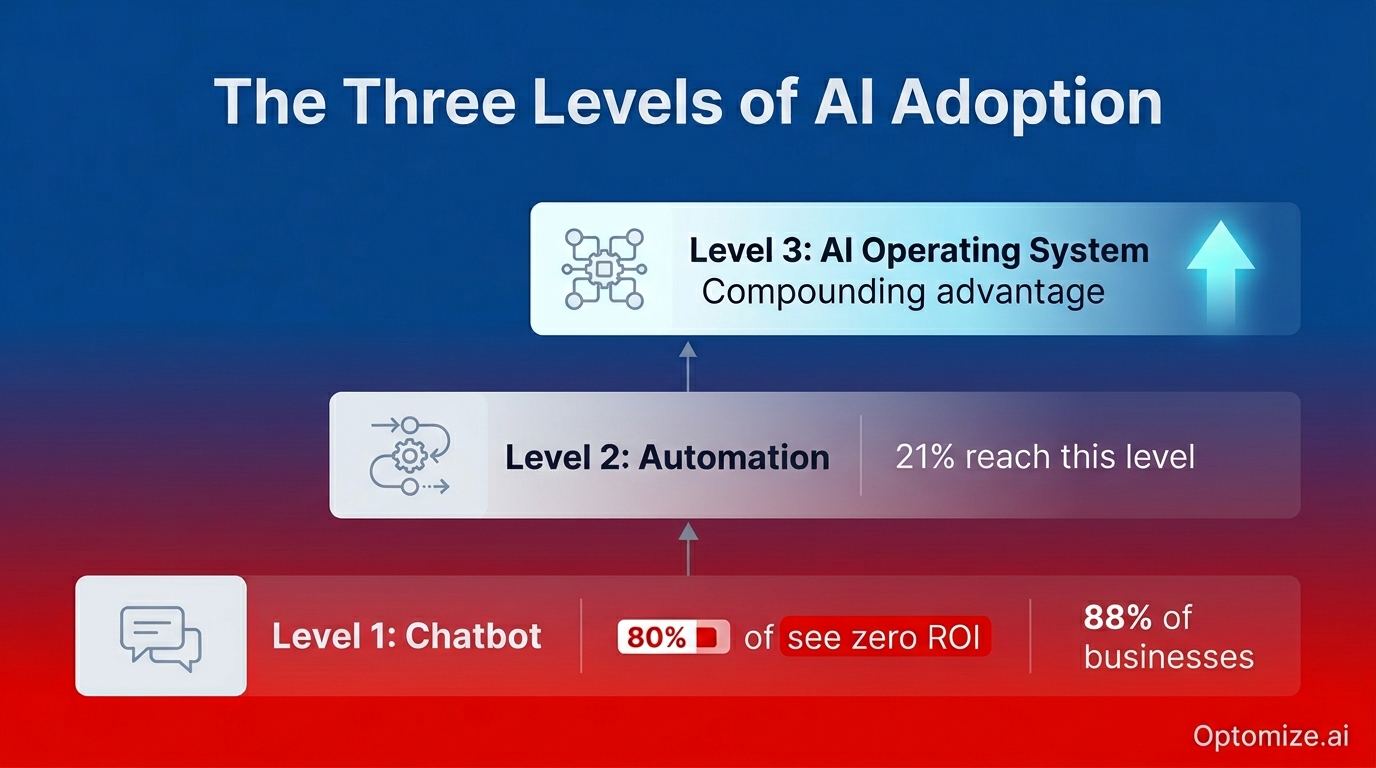
Three Levels of AI Adoption
Here’s a simple way to think about where you are:
Level 1: The Chatbot
You’re using ChatGPT or a chatbot for one-off tasks. Email drafts, brainstorming, document summaries. Helpful — but disconnected from your actual business.
This is where most companies are stuck. And 42% of them abandoned their AI projects last year because the results weren’t there.
Level 2: The Automation
You’ve automated specific workflows — maybe invoice processing, lead routing, or report generation. Real savings, real speed. But each automation lives in its own silo.
Your marketing AI doesn’t talk to your finance AI. You have automations, but you don’t have a system.
Level 3: The AI Operating System
AI runs your business the way electricity powers your office — you don’t think about it, it just works. Agents handle the repetitive stuff. Systems talk to each other. Your team focuses on the work that actually requires a human brain: strategy, relationships, creative decisions.
This is where the real advantage is. And the gap between Level 1 and Level 3 is getting wider every month.
Who’s Already Doing This?
Shopify
CEO Tobi Lutke told his entire company: prove AI can’t do the job before you ask to hire someone. AI is now baked into performance reviews. The result? Employees doing what Lutke calls “100X the work.”
JPMorgan Chase
250,000 employees use their AI platform daily. In one demo, an AI agent built a complete investment banking deck in 30 seconds. That’s not a chatbot — that’s an operating system running a bank.
Klarna
Their AI handled 2.3 million customer conversations in month one — replacing 700 agents. But then quality dropped. They had to bring humans back.
The lesson? A chatbot alone isn’t enough. You need the full system — AI speed combined with human judgment and quality controls.
The UAE Gets It
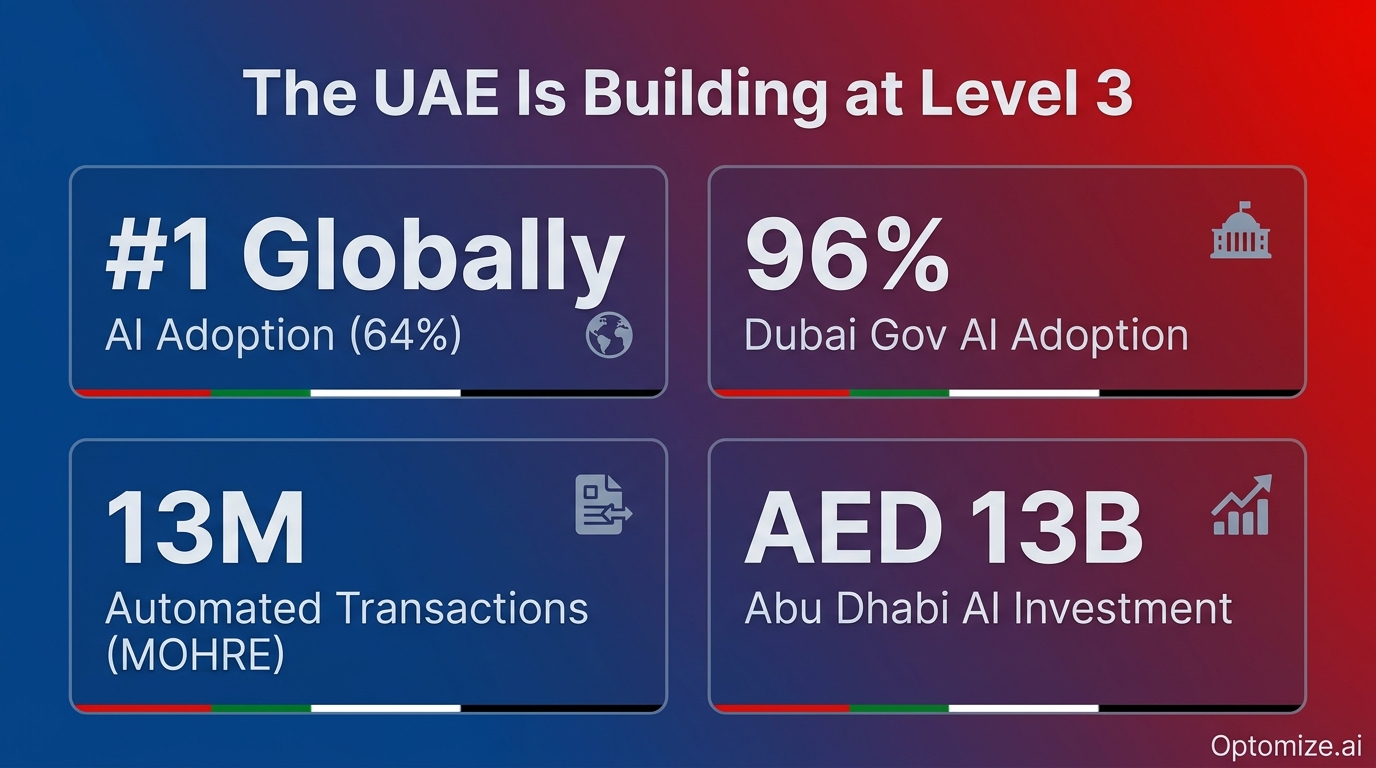
UAE AI Stats Dashboard
The UAE isn’t experimenting with AI — it’s already operating on it.
Abu Dhabi is investing AED 13 billion to become the world’s first AI-native government by 2027. Their app TAMM handles over 1,100 government services with AI, and it even takes care of things like license renewals before you ask. Dubai has AI running in 96% of its government entities. And MOHRE processed 13 million transactions last year with zero human involvement.
The UAE ranks #1 globally for AI adoption. First country to appoint an AI minister. First to build a graduate-level AI university.
If a government can run at this level, your business can too.
How to Get Started (3 Steps)
You don’t need to be JPMorgan. Start simple.
1. Map what you’ve got. List every AI tool and automation in your business. Where are they? What data do they use? Do any of them talk to each other?
2. Find your highest-value chain. Look for a process where multiple steps happen in sequence: lead comes in → gets qualified → proposal goes out → contract gets drafted → onboarding kicks off.
3. Connect and automate. Pick an orchestration tool and wire those steps together. Data flows through, decisions get made, humans only step in when real judgment is needed.
That’s it. One connected chain. Then build the next one.
The Optomize.ai Take
We’ve been building AI operating systems — for ourselves and for our clients — since day one. Our own content, onboarding, CRM, and business intelligence all run on connected AI workflows.
The pattern is always the same: businesses that use AI as a tool hit a ceiling. Businesses that build AI into their operating model see compounding returns every month.
You don’t need another AI tool. You need the system that makes all your tools work together.
Ready to move from chatbot to operating system? Book a discovery call with Optomize.ai — we’ll map your automation opportunities and show you exactly where to start.