
Why Your Business Needs an AI Agent Stack (Not Just ChatGPT)
By end of 2026, 40% of enterprise apps will run AI agents. Single AI tools can't keep up. Learn why businesses in Dubai and the UAE are building agent stacks — and how to start yours.

You have ChatGPT. Everyone has ChatGPT.
That's the problem.
82% of enterprise leaders now use generative AI weekly — and most of them are doing the same things: drafting emails, summarizing documents, answering basic questions. Meanwhile, the companies pulling ahead have moved on to something fundamentally different.
They're not using an AI tool. They're running an AI agent stack — multiple specialized AI agents working together, executing real business processes, across real systems, without someone babysitting every step.
And the gap between "uses ChatGPT" and "runs an agent stack" is becoming the gap between companies that grow and companies that stall.
What Exactly Is an AI Agent Stack?
Think of ChatGPT as a brilliant intern. You ask it a question, it gives you an answer. You give it a document, it gives you a summary. Useful — but it waits for you to ask, and it can't actually do anything in your business systems.
An agent stack is the step where that intern becomes a team of specialists who can take action.
An agent stack has an orchestrator — the brain that decides which specialist agent handles which part of a process. A Sales Agent qualifies leads. A Finance Agent reconciles invoices. A Content Agent drafts and schedules posts. A Support Agent triages tickets and escalates what it can't handle.
They work in parallel. They pass context to each other. They get things done while you're doing something else.
The Numbers Are Impossible to Ignore
This isn't theoretical. The market has already moved:
$7.6 billion — global AI agent market in 2025, growing to $10.9 billion in 2026 (44% YoY growth)
40% of enterprise applications will feature AI agents by end of 2026, up from less than 5% in 2025 (Gartner)
96% of enterprises plan to expand their use of AI agents (Cloudera)
Companies deploying agent stacks report an average ROI of 171% — and 74% see returns within the first year
That 5% to 40% leap in a single year is the fastest adoption curve enterprise tech has ever seen. This is the window.
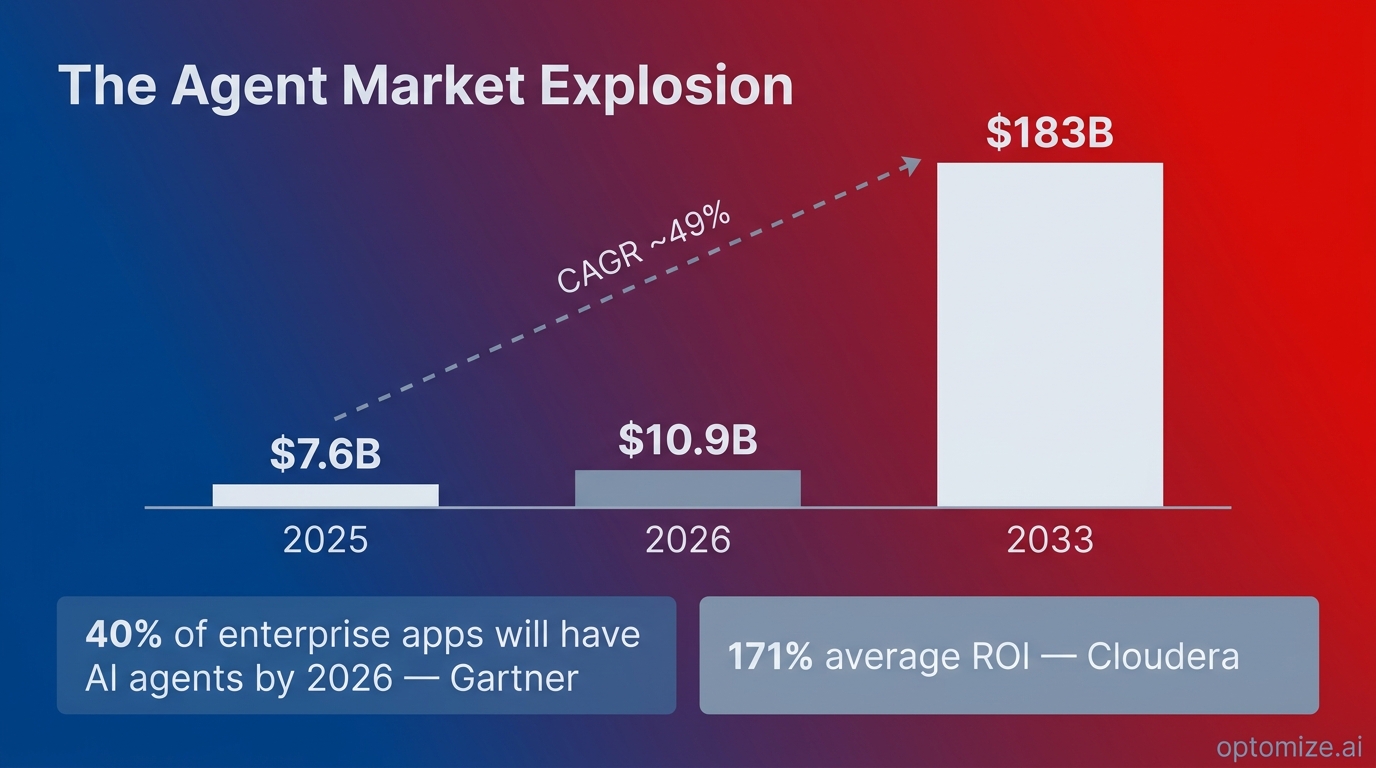
AI Agent Market Growth
Why ChatGPT Alone Hits a Ceiling
ChatGPT Enterprise is useful. But here's where it breaks down for real business operations:
It can't connect to your systems. Custom GPTs are locked inside the ChatGPT interface, mostly read-only. They can't write to your CRM, trigger an invoice, or update a project board. You're still the middleware — copying data between tabs.
It forgets. Files and context are only retained while the conversation is active. Your company knowledge resets with every new chat. There's no persistent, organization-wide memory.
One model does everything. ChatGPT uses OpenAI's models for every task. But some tasks are better handled by Claude (complex reasoning), Gemini (Google ecosystem integration), or smaller fine-tuned models (faster, cheaper, more accurate for specific workflows).
It can't orchestrate. You can't build a multi-step workflow where one AI hands off to another, decisions get made conditionally, and the whole process runs without human intervention. ChatGPT responds to prompts. Agent stacks execute processes.
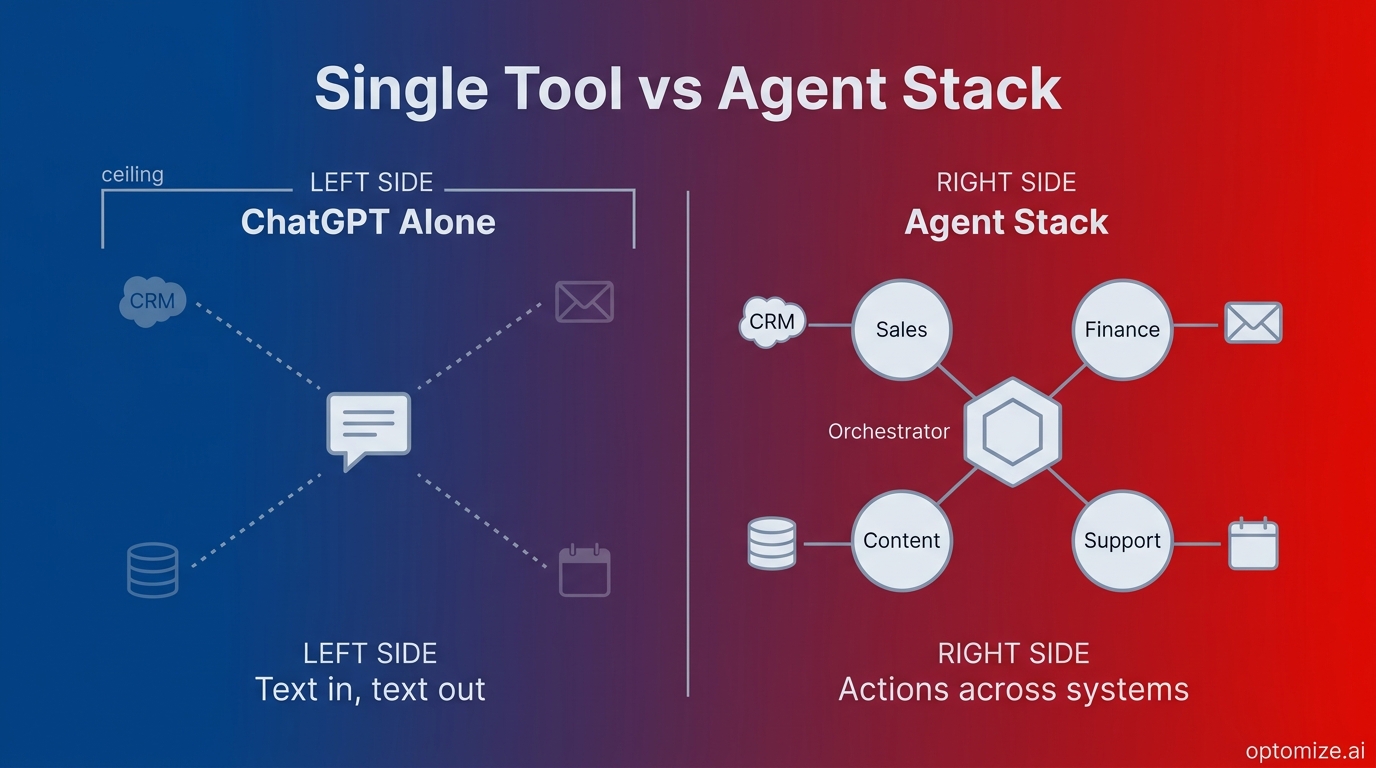
ChatGPT vs Agent Stack
Who's Already Running Agent Stacks?
Klarna: $60M Saved — Then the Course Correction
Klarna's AI agent handled two-thirds of all customer inquiries in its first month — 2.3 million conversations, equivalent to 700 full-time human agents. By Q3 2025, that number had grown to 853 agent-equivalents. Resolution time dropped from 11 minutes to under 2 minutes. Customer service cost per transaction fell 40% over two years.
Then quality dropped. Klarna brought humans back into the loop in a hybrid model.
The lesson isn't that agents failed. It's that agents without human judgment and quality controls fail. The winning architecture is agent + human, not agent instead of human.
JPMorgan Chase: AI as Infrastructure
Over 200,000 employees use JPMorgan's AI platform. In one demonstration, an AI agent built a complete investment banking deck in 30 seconds. This isn't a chatbot answering questions — it's AI embedded in how the bank operates.
Intercom: 51% Automated Resolution
Intercom's Fin AI Agent automatically resolves 51% of customer conversations across their customer base. Synthesia saved 1,300 support hours in six months, resolving over 6,000 conversations through their agent setup.
The UAE Isn't Waiting
While most businesses are debating whether to upgrade their ChatGPT subscription, the UAE government literally put AI inside the federal cabinet.
In June 2025, Sheikh Mohammed announced that a National Artificial Intelligence System would serve as an advisory member of the UAE Cabinet starting January 2026 — providing real-time analysis, policy simulations, and data-driven recommendations to the Ministerial Development Council. No other nation has placed an AI system at ministerial-level access.
And that's just the federal level:
Abu Dhabi is investing AED 13 billion to become the world's first fully AI-powered government by 2027
52% of DIFC financial firms now use AI, up from 33% in 2024 — the fastest jump in the region's financial sector
Companies across Dubai's free zones are deploying AI agents for supply chain logistics
DIFC firms are automating KYC/AML processing and regulatory reporting with multi-agent systems
Companies across the UAE are targeting significant reductions in manual work through AI agent deployment
The UAE ranks #1 globally for AI adoption and targets 20% of non-oil GDP from AI by 2031. If you're operating in this market and still treating AI as a chatbot, you're already behind the curve set by your own government.
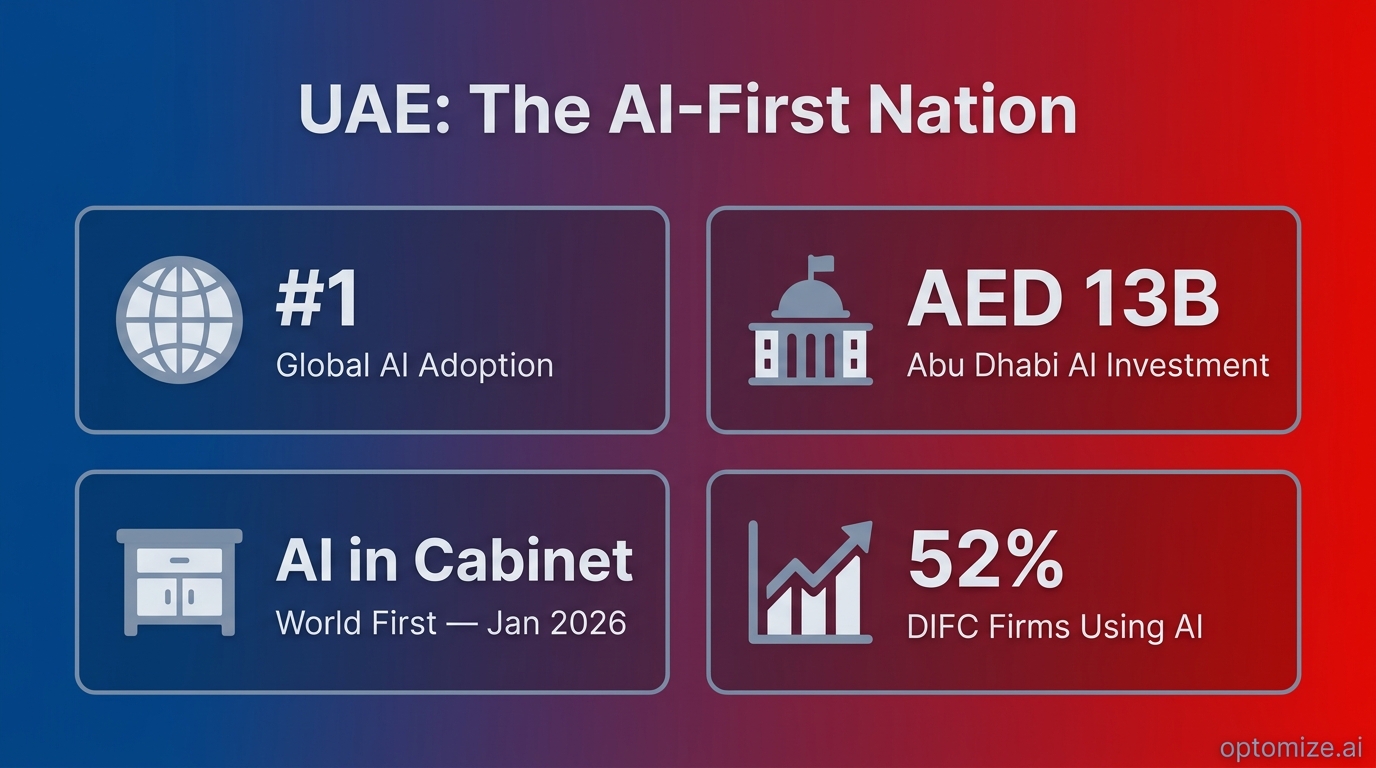
UAE AI Leadership Stats
What an Agent Stack Actually Looks Like
You don't need to build something as complex as a national AI advisory system. Here's what a practical agent stack looks like for a mid-size business:
The Orchestrator
The brain. It receives incoming triggers (new lead, support ticket, invoice received) and routes them to the right specialist agent. Think of it as a dispatcher.
Specialist Agents
Each one handles a domain:
Sales Agent — qualifies leads, researches companies, drafts personalized outreach
Finance Agent — extracts invoice data, reconciles payments, flags anomalies
Content Agent — researches topics, drafts posts, schedules across platforms
Support Agent — triages tickets, resolves common issues, escalates edge cases
Analytics Agent — monitors KPIs, surfaces anomalies, generates reports on demand
The Human Layer
You approve what matters. You make judgment calls. You handle the 20% of situations that require nuance and relationships. The agents handle the 80% that's repetitive, time-sensitive, or data-heavy.
How to Start Building Yours
Don't try to boil the ocean. Start with one workflow and expand.
1. Pick your most painful process. Find the workflow that eats the most time and involves the most manual handoffs.
2. Map the handoffs. Every time a human copies data from one system to another, or makes a routine decision that follows a clear pattern — that's an agent opportunity.
3. Choose your framework. For business teams: n8n or Zapier Agents (visual, no-code). For technical teams: LangGraph, CrewAI, or Claude Agent SDK (code-first, full control).
4. Build one chain, then the next. Connect two agents. Test. Add a third. The companies that succeed wire up one process end-to-end and expand from there.
The Honest Warning
Not every agent project works. Gartner predicts over 40% of agentic AI projects will be cancelled by 2027 — largely due to poor governance, lack of observability, and unclear ROI targets.
Agent stacks work. But they work because of the architecture around them, not because of the AI itself.
The Optomize.ai Take
We run our own business on an agent stack. Our content pipeline, lead outreach, CRM updates, financial tracking, and ad creation all run through coordinated AI agents — with human approval at every critical decision point.
ChatGPT was the starting line. The agent stack is the race. And the best time to start building yours was six months ago. The second best time is now.
Ready to build your agent stack? Book a discovery call with Optomize.ai — we'll map your highest-value automation opportunities and design the architecture to connect them.