
Vibe Coding Is Fine. Shipping It Blind Isn't.
AI-built apps ship fast — and studies show ~45% ship with security flaws. What to fix in your vibe-coded app before real users, real data, and real bills arrive.

An AI wrote your app. That's not the problem. The problem is that nobody read what it wrote before you put real users, real payments, and real data behind it.
"Vibe coding" — describing what you want in plain English and letting an AI build it — has quietly become one of the most productive things to happen to software in a decade. A founder with an idea and no engineering team can now have a working product by the weekend. In a region like ours, where the UAE is pushing hard on AI adoption and new ventures launch every week, that's genuine leverage. We're not here to talk anyone out of it.
But there's a gap most people don't see until it bites them: the code that gets you to a demo is not the code that survives contact with the public. A prototype only has to impress you. A production app has to withstand paying customers, curious strangers, and the occasional person actively trying to break in. AI is very good at the first job and, left unsupervised, quietly terrible at the second.
Here's what that gap actually looks like — and what to fix before you flip your app to public.
1. Security: the AI writes the feature, not the guardrails
When you ask an AI to "add user login" or "let users save their data," it will happily build the feature. What it usually won't do — unless you know to ask — is lock the door behind it.
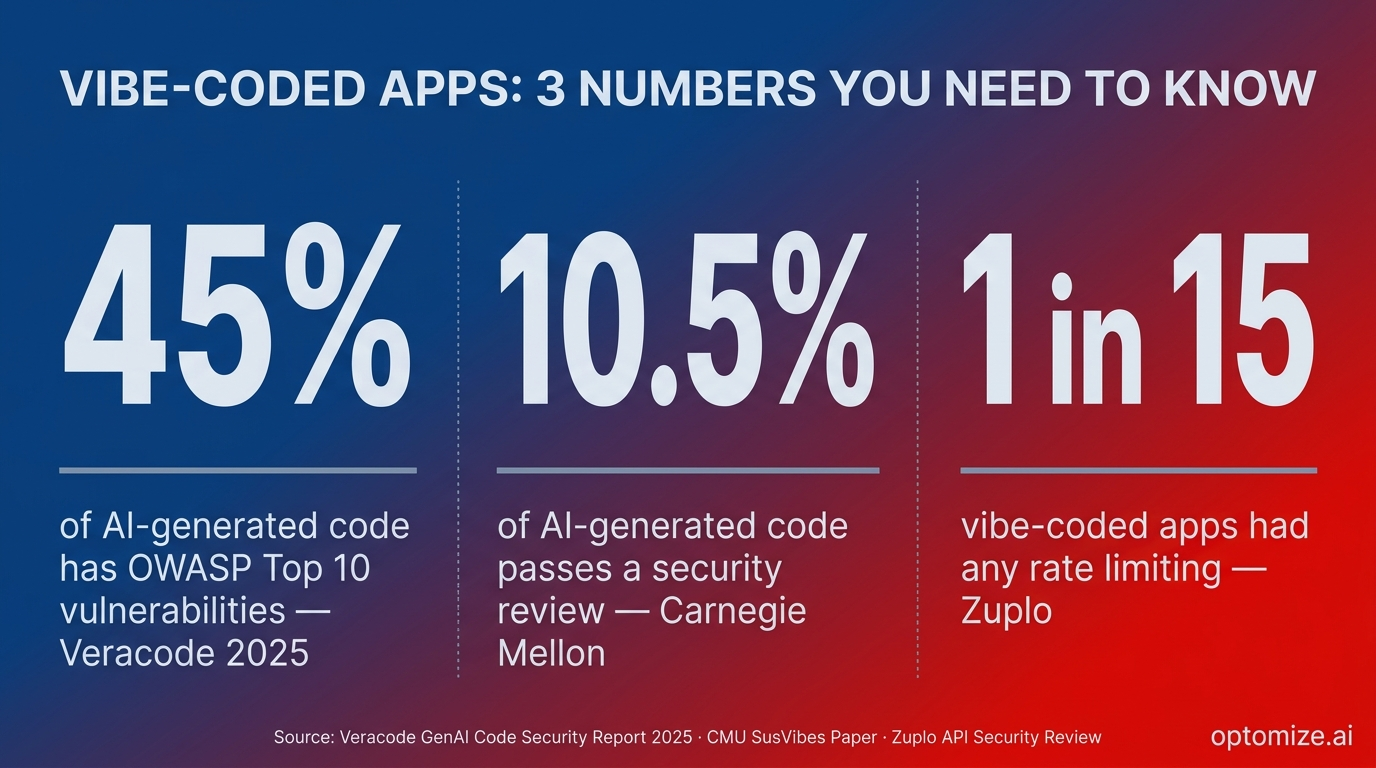
The numbers on this are not subtle. Veracode's 2025 GenAI Code Security Report tested more than 100 large language models and found that **45% of AI-generated code contained vulnerabilities** from the OWASP Top 10 — the industry's list of the most common, most exploited security flaws. A separate analysis by OX Security put the figure even higher. And Carnegie Mellon researchers found that while roughly 61% of AI-generated code functions correctly, only about 10.5% passes a security review.
This isn't theoretical. In early 2026, an AI-built social app called Moltbook — whose founder openly said he "didn't write a single line of code" — exposed its entire production database within days of launch. Security researchers found roughly 1.5 million API authentication tokens, 30,000 email addresses, and private user messages sitting wide open. The cause was almost boringly common: the database key was left exposed in the browser-side code, and the access rules that would have stopped strangers from reading everyone's data were never switched on.
That same missing setting has a name and a track record. A documented vulnerability (CVE-2025-48757) traced missing access-control rules across more than 170 live applications built on one popular AI app builder. And when the security firm Escape.tech scanned around 5,600 public vibe-coded apps in late 2025, it reportedly found over 2,000 high-impact vulnerabilities, more than 400 exposed secrets like API keys, and 175 apps leaking personal data — including medical records and bank account numbers.
The AI didn't decide to be insecure. It just did exactly what you asked, and nothing you forgot to ask.
2. Cost: the bill that arrives after the damage is done
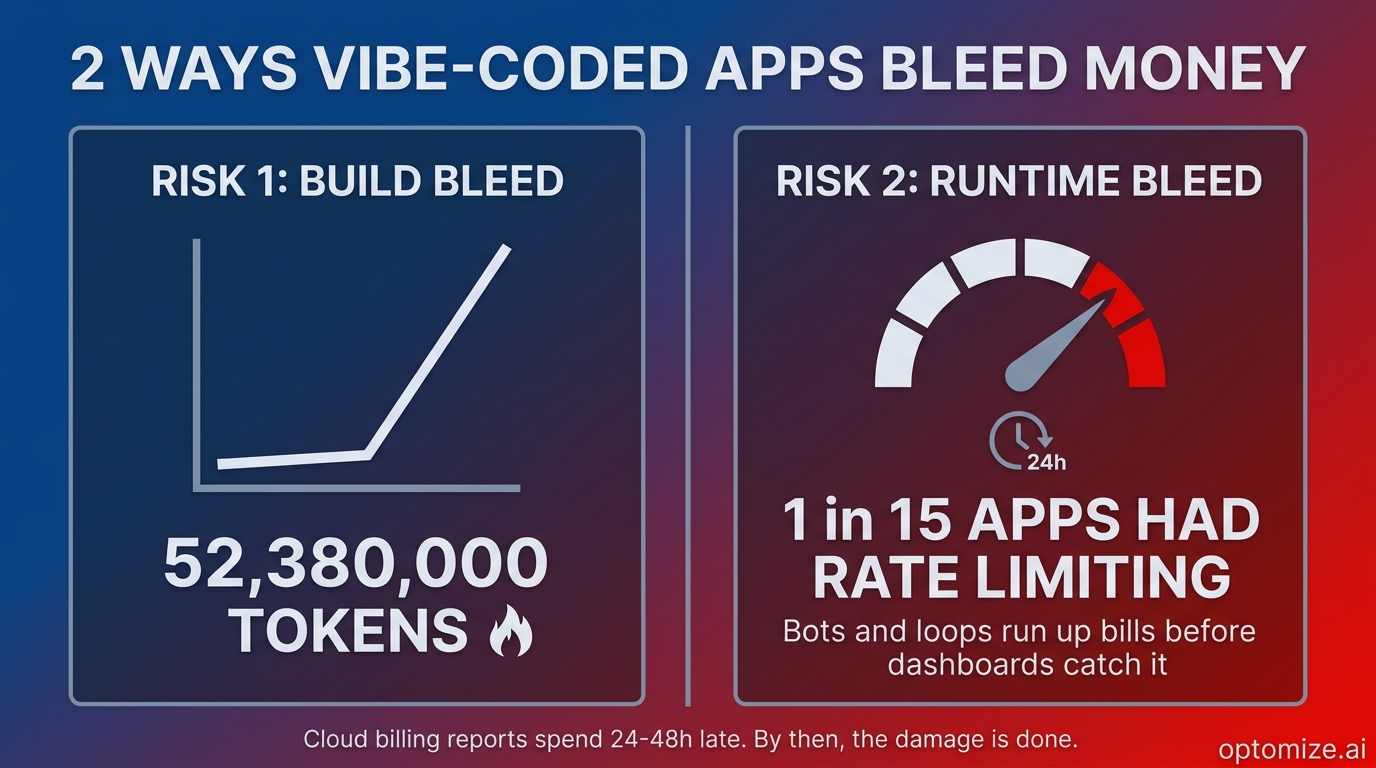
The second surprise is financial, and it lands in two waves.
The build itself can run away from you. Because AI coding tools charge by the token and re-read your entire project on every request, costs compound fast. There are documented cases of developers burning through tens of millions of tokens to produce a few hundred lines of working code. A "cheap" monthly plan can evaporate in an afternoon of back-and-forth.
The live app can bleed money quietly. This is the one that hurts. If your app calls an AI model, a payment processor, or any paid service, it needs rate limiting — a cap on how often anyone can trigger those calls. AI-generated code almost never includes this by default. In one review of 15 vibe-coded apps, only one had any rate limiting at all. Without it, a single misbehaving user — or a bot, or a bug in a loop — can rack up thousands of dirhams in usage before you notice. And cloud billing dashboards typically report spend a day or two late, so by the time you see the number, the money is already gone.
body-1-security-stats
3. Multi-tenancy: the one bug that can end the business
This is the risk almost nobody thinks about, and it's the most dangerous.
If your app serves multiple customers — the definition of most SaaS products — every user's data lives in the same database. The only thing keeping Customer A from seeing Customer B's information is a layer of rules that says this data belongs to that person, and only that person can see it. Get it right and it's invisible. Get it wrong and it's catastrophic.
AI tools get it wrong constantly, because "show the user their data" and "show the user only their data" look almost identical in a prompt — and the AI builds the version that demos well. The result is called cross-tenant leakage, and it's consistently cited as one of the most serious API security risks in the industry. One customer stumbles into another customer's records. In a B2B product, that's not a bug report — that's a lost contract, a broken NDA, and a reputation you don't get back.
body-2-pre-launch-checklist
The pre-launch reality check
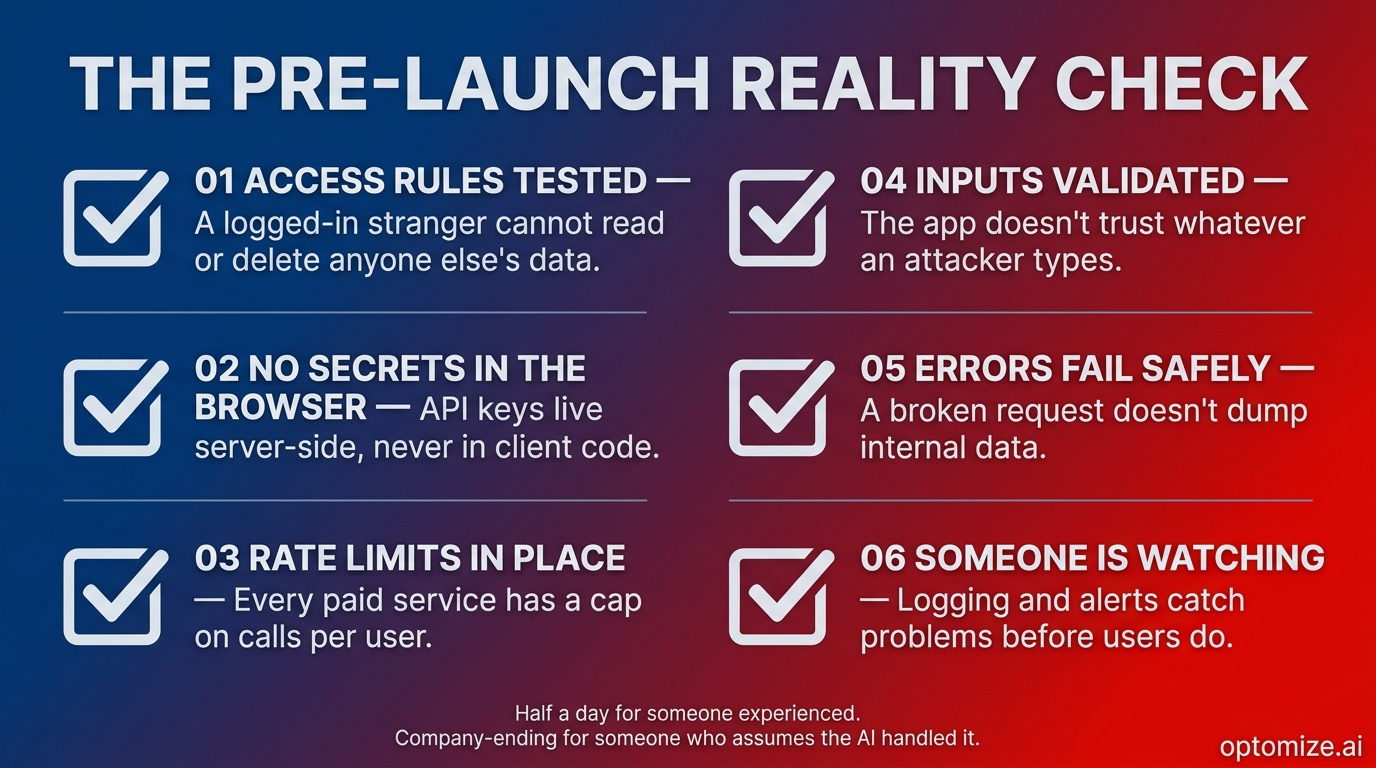
None of this means "don't vibe code." It means don't ship a vibe-coded app to the public without a review. Before you go live, someone who knows what they're looking for should confirm:
Access rules are on and tested — a logged-in stranger genuinely cannot read, edit, or delete anyone else's data.
No secrets in the browser — API keys, database credentials, and tokens live on the server, never in code the user's browser can see.
Rate limits and spend caps exist on every paid service the app touches.
Inputs are validated — the app doesn't blindly trust whatever a user (or attacker) types into a form.
Errors fail safely — a broken request doesn't dump internal details or leave data half-written.
Someone is watching — you have logging and alerts so you find out about a problem before your users do.
That's a half-day audit for someone experienced. It's a company-ending oversight for someone who assumes the AI handled it.
body-3-cost-risks
Where Optomize fits
We're not anti-AI — we build with these tools every day, and we think shipping fast is the right instinct. What we do is close the gap between "it works on my screen" and "it's safe to hand to the public." That means a focused security and architecture review of your vibe-coded app, hardening the access rules, capping the costs, fixing the multi-tenancy, and getting it genuinely ready for launch — without slowing your momentum or rebuilding what already works.
If you've built something with AI and you're about to put it in front of real users, get it reviewed before you flip the switch, not after the breach. Talk to us — a short conversation now is a lot cheaper than an incident later.