
What 6 Months of Running an AI-Powered Business Actually Looks Like
Not a theory piece. A real account of what changed — and what didn't — after building AI systems into every part of running Optomize.ai for six months.

I run an AI consultancy. Which means the pressure to actually practice what I preach is real.
Six months ago I made a decision: every repeatable process in the business gets automated or AI-augmented before I hire for it. Not as an experiment — as a rule.
Here's what I built, what broke, what surprised me, and what I'd do differently.
What I Actually Built
Let me be specific, because "we use AI" means nothing.
A Chief of Staff agent — every morning at 8am, before I look at my phone, a briefing has already landed in my Telegram. Calendar for the day. Unread emails summarised. Every open deal in HubSpot with how many days since last contact. If a deal has gone cold, it flags it. I've had 8 deals sitting stale for 21 days — I know exactly which ones and why, every single morning, without opening a CRM.
A content pipeline — I brief a topic, the system researches trending angles, cross-references what I've already published to avoid repetition, drafts an article, fact-checks every claim, generates branded images, and uploads a preview for my review. I approve or edit from a dashboard. One click publishes to the website, LinkedIn, and Facebook. The whole thing — from topic to live post — takes me about 15 minutes of actual attention.
A lead pipeline — scrapes, verifies, researches, and drafts personalised outreach for every prospect. By the time I see a lead, there's already a brief on their business, what they likely need, and a first email ready to review.
Client delivery infrastructure — for Yellow Branding, a multi-model image generation system (Gemini Flash + custom routing) that produces campaign visuals on demand. For Unlimits.com, a goal-tracking and behavioural nudge agent. These aren't demos. They're in production, used weekly.
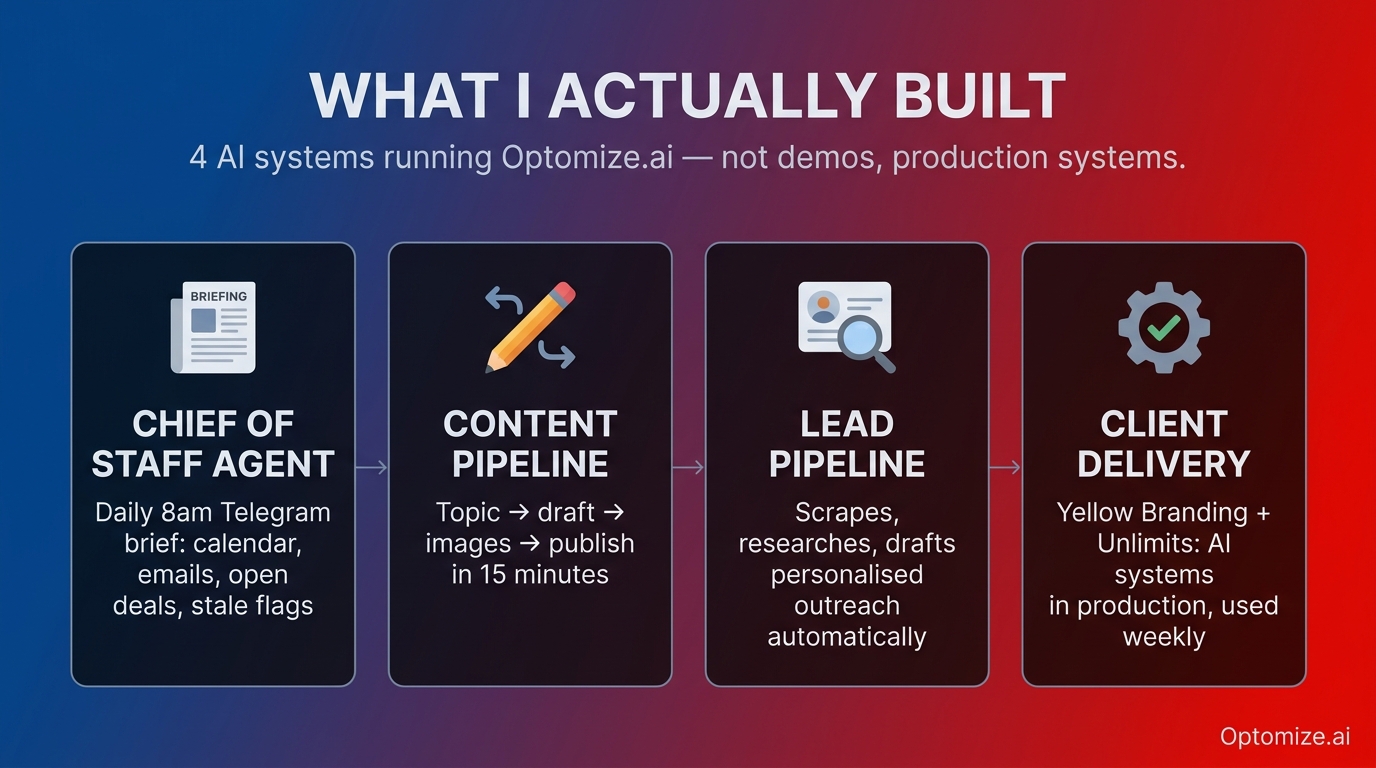
4 AI Systems Built
What Actually Changed Day-to-Day
The honest answer: the texture of work changed more than the volume of work.
I spend less time doing and more time deciding. The system generates, I direct. That sounds simple. In practice it means my calendar is almost entirely client-facing and strategic — there's very little operations work left that requires my hands.
The morning briefing alone changed something I didn't expect: I stopped carrying context anxiety. Before, the low-level dread of "what am I missing?" was always there. Now it's resolved before breakfast.
Deal follow-ups are the clearest ROI. I have 8 open deals. Three are contract-sent. In the old world, I'd rely on memory and willpower to stay on top of them. Now the system tracks staleness, drafts follow-ups, and I just review and send. The pipeline doesn't slip because I'm busy.
What Broke (Or Never Worked)
Integrations are the graveyard of automation ambitions.
OAuth tokens expire. APIs change. A Facebook access token that worked in January stops working in March and you don't find out until a post fails silently. I've had to rebuild integrations more than I expected — not because the AI logic failed, but because the plumbing underneath shifted.
Build reconnection into the system, not just the happy path. Every integration I've built now has a health check, a fallback notification, and a clear process for re-authentication. The first versions didn't.
The other thing that didn't work: fully automated publishing. I tried it once. The system published a post that was technically correct but tonally off for the moment — it didn't know about something happening in the news that made the angle land wrong. Now nothing publishes without my eyes on it first. The AI drafts, I approve. That boundary has held.
The Real Numbers
I'm not going to fabricate metrics I don't have precise data on. What I can say:
Time on operations: down significantly. Tasks that used to take an afternoon — content research, lead briefing, CRM hygiene — now take minutes of my attention. At least a 3x gain.
Content output: 6 published blog posts in 1 week after building the pipeline. Before: 6 in 2 months.
Deals in pipeline: 8 active. All being tracked. None falling through the cracks.
Client delivery: Multiple AI systems in production for clients, built and deployed within engagement timelines.
The number I care most about: zero dropped balls. Not because I'm more disciplined — because the system catches what I'd miss.
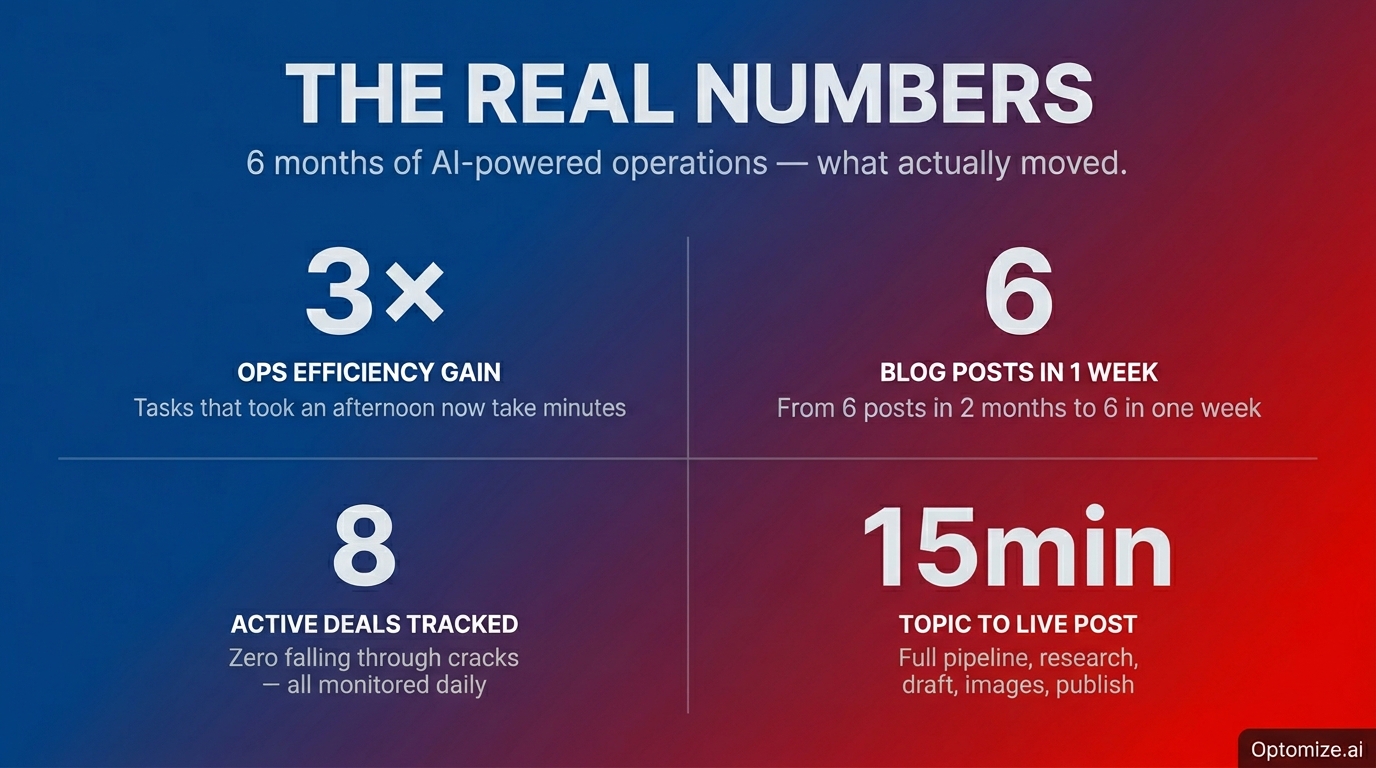
The Real Numbers
What I'd Do Differently
Start with the briefing system. The morning briefing was the highest-leverage thing I built. It changed how I start every day and eliminated an entire category of cognitive overhead. If you're only going to do one thing, do that.
Don't automate publishing until you've automated drafting. The urge is to get to the end state — fully automated, post goes live without you. Resist it. The value is in having a draft ready to review, not in removing yourself from the loop entirely. The review step is where you catch things the system can't.
Build for reconnection from day one. Every external integration will break. Design for it. Health checks, re-auth flows, fallback alerts. The 20 minutes you spend on this upfront saves you hours of silent failures later.
Accept that the system will surface things you don't want to see. Stale deals. Unanswered emails. Overdue tasks. An AI that's actually doing its job will show you the uncomfortable things consistently. That's the point. Don't build dashboards you're afraid to open.
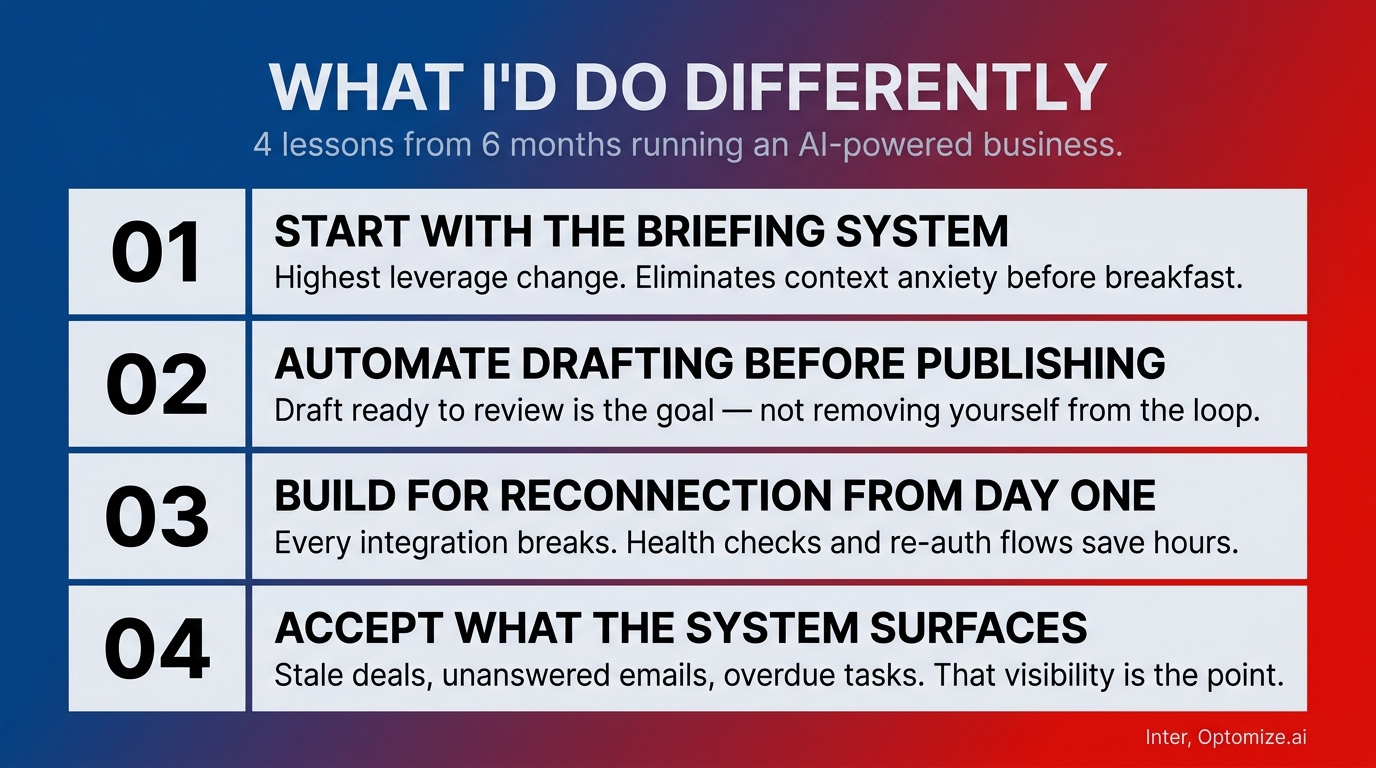
Key Lessons
The Uncomfortable Truth About AI-Powered Business
Most AI tools are productivity theatre. They look impressive in demos, generate output efficiently, and change nothing about how the business actually runs.
What I built is different because it's integrated into how I work, not bolted onto the side of it. The morning briefing isn't an app I open — it's waiting for me. The content pipeline isn't a tool I use — it's a process that runs. The deal tracker isn't a dashboard I check — it reports to me.
That distinction — between AI as a tool you pick up and AI as a system that runs — is the difference between 10% productivity gains and actually operating differently.
Six months in: we're a small team running like a team of at least 5x the size.
Siddharth Varerkar is the founder of Optomize.ai, an AI automation consultancy based in Dubai. He helps businesses build practical AI systems that generate measurable operational and revenue outcomes.