
The Real Cost of Waiting: What UAE Businesses Lose Every Month Without AI Automation
Every month without AI automation costs UAE businesses thousands in wasted payroll. Here's the real math — and what to do about it.

Nobody sends you an invoice for the automation you didn't build.
That's the problem. When a supplier overcharges you, it shows up in Zoho. When a campaign underperforms, it shows up in the dashboard. But when your team spends every month doing work a system should be doing, the cost arrives disguised as normal — payroll that buys fewer outcomes than it should, deals that close slower than they could, and a to-do list that never gets shorter.
The cost of waiting is real, it's monthly, and in the UAE right now it's growing faster than almost anywhere on Earth. Here's the math.
The math nobody runs
Start with a number you already know: what an hour of your team's time actually costs.
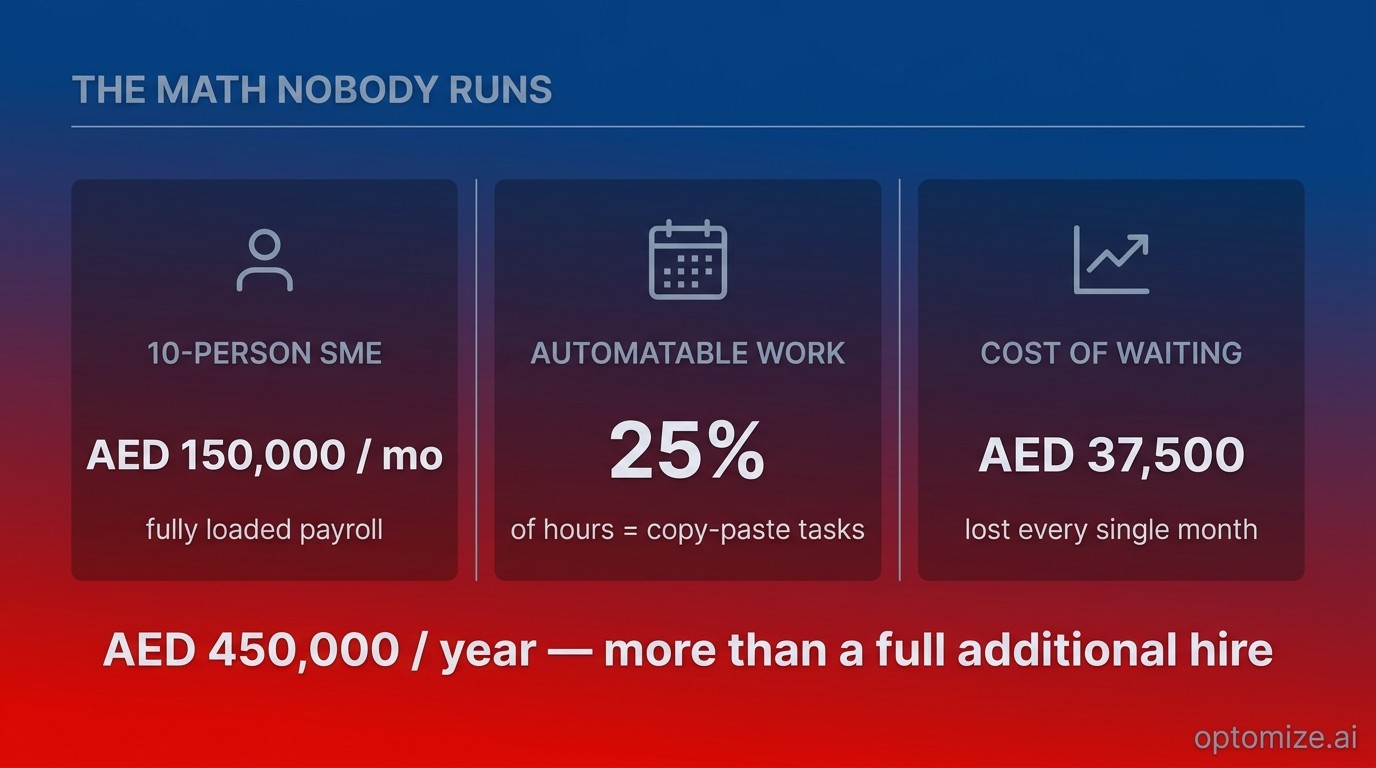
Take a typical 10-person Dubai SME with a fully loaded payroll of around AED 150,000 a month. Global research is remarkably consistent on how much of that time goes to manual, repetitive work: a study of more than 10,000 office workers by Automation Anywhere found people average over three hours a day on manual, repetitive tasks — roughly 60 hours per person, per month. Smartsheet's research puts it at about a quarter of the work week. McKinsey research has put the automatable share of knowledge work even higher.
Be conservative and call it 25%. For that 10-person firm:
AED 37,500 a month of payroll is going to copy-paste work: re-keying data between systems, chasing invoices, formatting reports, drafting the same email for the tenth time
That's AED 450,000 a year — for many SMEs, more than an entire additional hire's output, spent producing nothing a customer would pay for
And that's before counting the errors, the delays, and the follow-ups that manual work generates on top
Automation doesn't recover all of it. It doesn't need to. Recover even half and you've funded the entire automation programme several times over — every month, forever.
The question isn't “what does AI automation cost?” It's “what is not having it costing you right now?” For most SMEs, the second number is bigger. Every month.
Cost Math
Waiting is a choice about your competition, not your technology
Here's what makes 2026 different from every previous "adopt or fall behind" pitch: in the UAE, the baseline has already moved.
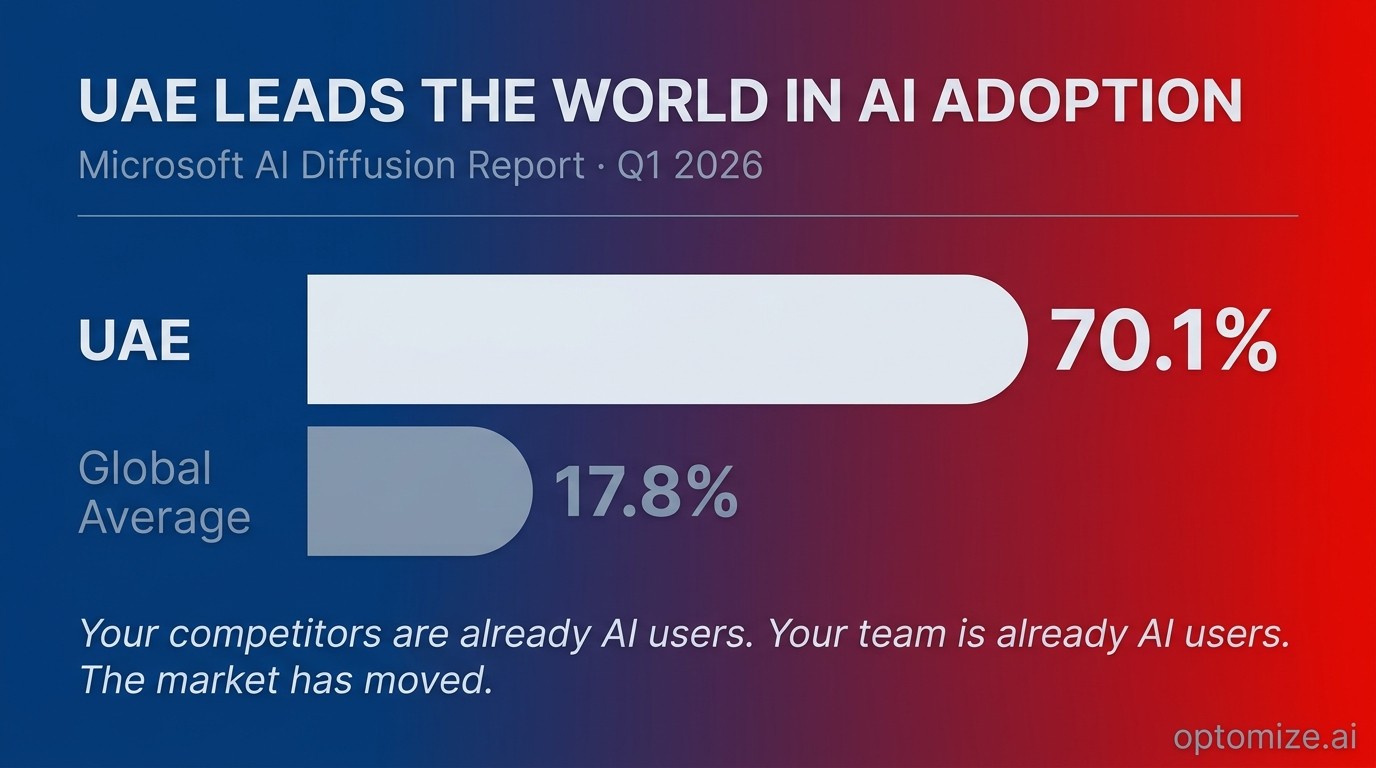
According to Microsoft's AI Diffusion report, the UAE now leads the world in AI adoption — 70.1% of the working-age population uses AI regularly, against a global average of just 17.8%. Your employees are already AI users. Your customers are already AI users. Increasingly, your competitors are too — and PwC Middle East estimates AI will contribute up to US$96 billion to the UAE economy by 2030, close to 14% of GDP.
In a market like that, "we'll look at AI next year" isn't a neutral decision. It's a decision to spend a year widening the gap between your cost base and your competitor's.
UAE Adoption
Dubai just made the direction of travel official
In May 2026, Sheikh Hamdan bin Mohammed launched a two-year programme to bring agentic AI to Dubai's private sector — not chatbots, but AI agents that actually execute work. The plan: empower 295,000 companies, deliver 100 specialised agentic AI solutions, and support the launch of 50 new agentic AI companies, all within two years.
Read that as the gift it is. Dubai's government is effectively de-risking AI adoption for its private sector — building the rails, the solutions, and the ecosystem so that companies of every size can run on them. Few places in the world hand businesses that kind of head start.
But a head start only helps the businesses that take it. When 295,000 companies are being actively equipped with agents that handle operations end-to-end, the companies still running on manual processes won't be standing still — they'll be moving backwards relative to everyone around them.
The costs that compound quietly
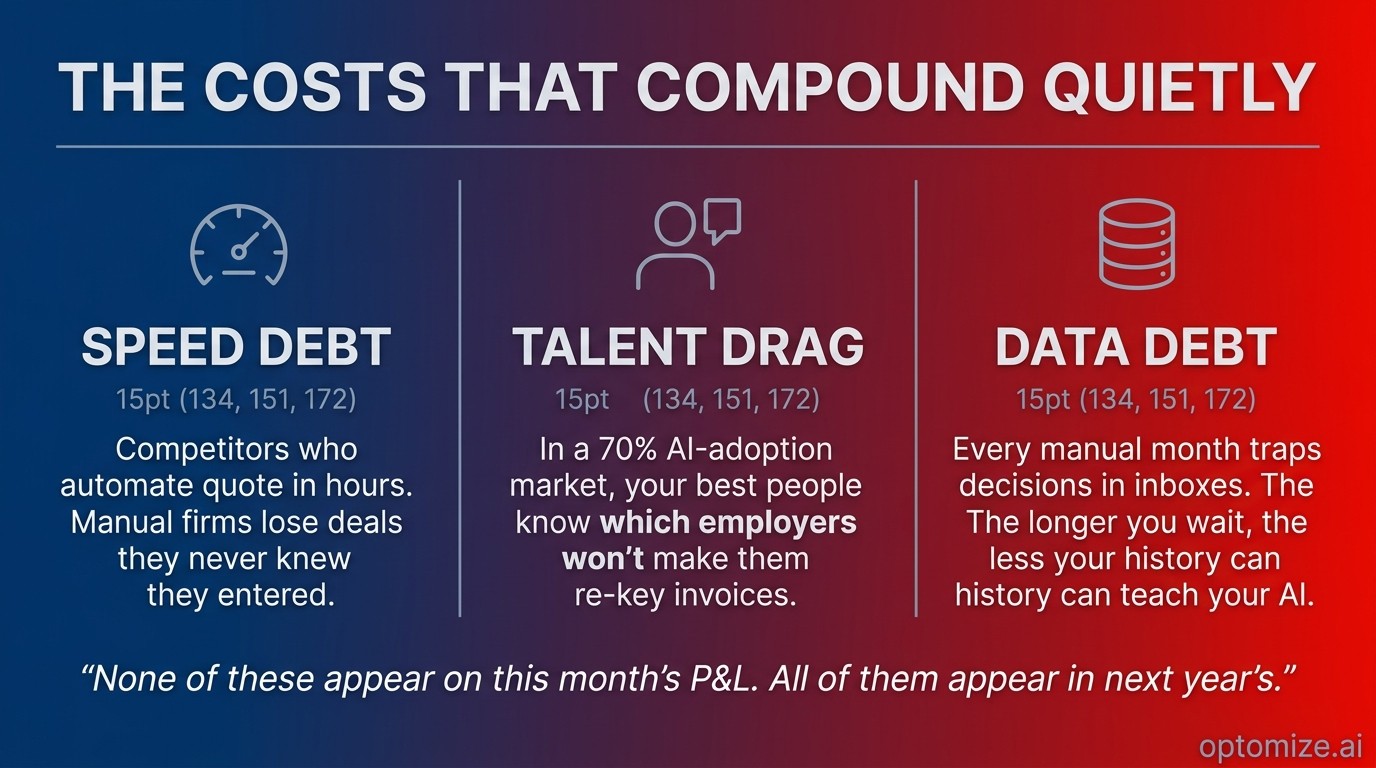
The payroll math is the visible cost. Three more accumulate underneath it:
Speed debt. The firm that quotes in an hour beats the firm that quotes in three days — at the same price. Manual back-offices lose deals they never even knew they were competing for.
Talent drag. People don't leave companies because the work is hard; they leave because it's boring. Your best operators didn't join you to re-key invoices, and in a 70%-adoption market they know exactly which employers will let a machine do it instead.
Data debt. Every month of manual process is a month of decisions trapped in inboxes and spreadsheets — invisible to the AI systems you'll eventually deploy. The longer you wait, the less your history can teach them.
None of these show up in this month's P&L. All of them show up in next year's.
Hidden Costs
What not-waiting actually looks like
Here's the part the doom-clock pitches get wrong: closing the gap doesn't mean a moonshot transformation programme. The businesses getting real returns started embarrassingly small.
At Optomize, the playbook we run with clients is deliberately boring:
Map one week of repetitive work. Where do the hours actually go? Usually three to five processes account for most of the waste.
Automate the single worst offender first. One workflow, end-to-end — not a chatbot bolted onto the side, but an agent that finishes the job: the quote goes out, the invoice gets chased, the report writes itself.
Measure the recovered hours, then reinvest them. The first automation typically pays for the second.
We run our own business this way — our content pipeline, approvals, and reporting are agent-operated — so the numbers above aren't theoretical to us. They're our operating budget.
The cost of waiting is charged monthly, in arrears, with no invoice. The only way to stop paying it is to start.
Want to know your number? Book a free AI audit and we'll map where your hours are going — and what it would take to get them back.