
Claude Fable 5: The AI Model That Was Too Powerful to Release — Until Now
Anthropic just made its most powerful AI model publicly available. Here's what Claude Fable 5 means for your business, what it can do, and what the catches are.

A few weeks ago, Stripe handed an AI system a 50-million-line Ruby codebase and asked it to help with a migration. The task would normally take two months. It took one day.
That AI system was Claude Fable 5 — and if you haven't heard about it yet, you will.
On June 9, 2026, Anthropic made its most powerful model ever available to the public. Not in a limited preview. Not for a select list of enterprise customers. For anyone with a Claude subscription or API key.
Here's what changed, why it matters, and — critically — what the catches are before you build anything serious on top of it.
What Is Claude Mythos (And Why You Couldn't Have It Until Now)
To understand Fable 5, you need to know about Mythos.
Claude Mythos is Anthropic's frontier AI model — the one they built for maximum capability with minimal restrictions. It can autonomously find zero-day software vulnerabilities across entire codebases, accelerate molecular biology research by 10x, and work on long-horizon tasks without needing human checkpoints every few steps.
That last part is the key distinction. Most AI models need constant supervision. Mythos doesn't.
The problem: those same capabilities that make it extraordinary in the right hands make it dangerous in the wrong ones. Unrestricted access to a model that can find security vulnerabilities at scale, or help design biological agents, isn't something you hand out publicly.
So Anthropic didn't. Until recently, Claude Mythos was available only to roughly 150 organizations through a restricted program called Project Glasswing — think US government agencies, critical infrastructure operators, and a handful of vetted research institutions. Everyone else got Opus 4.8.
That changes now.
Enter Fable 5: Mythos for Everyone
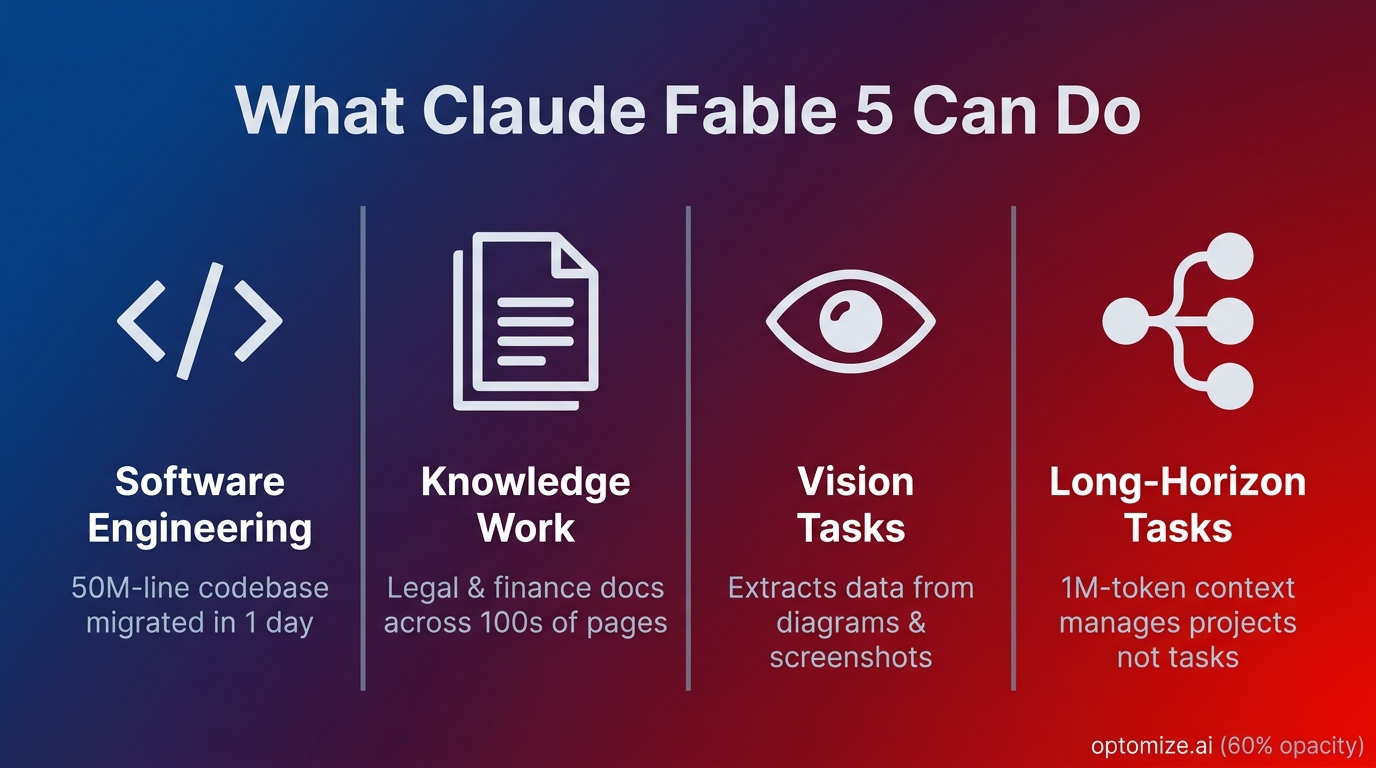
Capabilities Overview
Claude Fable 5, released June 9, is the first publicly available Mythos-class model. Same architecture. Same core capabilities. The difference: Anthropic layered in separate AI safety classifiers that monitor every session and, when they detect a potential misuse pattern, silently route the request to the less capable Opus 4.8 instead.
The result: 95% of sessions run on full Fable 5 without interruption. The remaining 5% — queries touching offensive cybersecurity, bioweapons-adjacent biology, or attempts to extract the model's capabilities for competing systems — get downgraded without the user knowing.
More on that last part in a moment. First, let's talk about what Fable 5 actually does.
What Fable 5 Can Actually Do
Benchmarks are useful for researchers. For the rest of us, outcomes matter more.
Software engineering
Stripe's 50-million-line migration story isn't a cherry-picked edge case. It's a signal of what becomes possible when an AI can hold an entire codebase in context and execute multi-step tasks without stopping every 20 minutes to ask for confirmation.
The Cursor CEO put it directly: "Claude Fable 5 is the state of the art model on CursorBench. It's opened up a class of long-horizon problems that were out of reach."
GitHub's CPO described "a level of autonomy and reliability that exceeded previous benchmarks" on complex coding tasks.
For businesses building or maintaining software — this is a meaningful productivity shift, not a marginal one.
Knowledge work
Fable 5 scored highest on Hebbia's Finance Benchmark, a test designed around the kind of messy, multi-document reasoning that financial analysis actually requires — not clean, structured data.
It handles document reasoning, chart interpretation, and problem-solving across hundreds of pages. Legal review, financial due diligence, compliance analysis: these are use cases where Fable 5 moves the needle.
Vision
Previous Claude models could "see" images but struggled with precision. Fable 5 is now state-of-the-art on vision tasks — extracting exact numbers from scientific figures, interpreting complex diagrams, and — most practically — rebuilding working web application code from screenshots alone.
That last capability matters more than it sounds. Visual interfaces are everywhere in business operations. Fable 5 can now work with them directly, without custom integrations.
Long-horizon tasks
Fable 5 ships with a 1-million-token context window and persistent file-based memory, showing three times greater performance improvement than Opus 4.8 on complex tasks that require maintaining context across extended sessions.
Translation: it can manage projects, not just tasks.
What This Means for Your Business Workflows
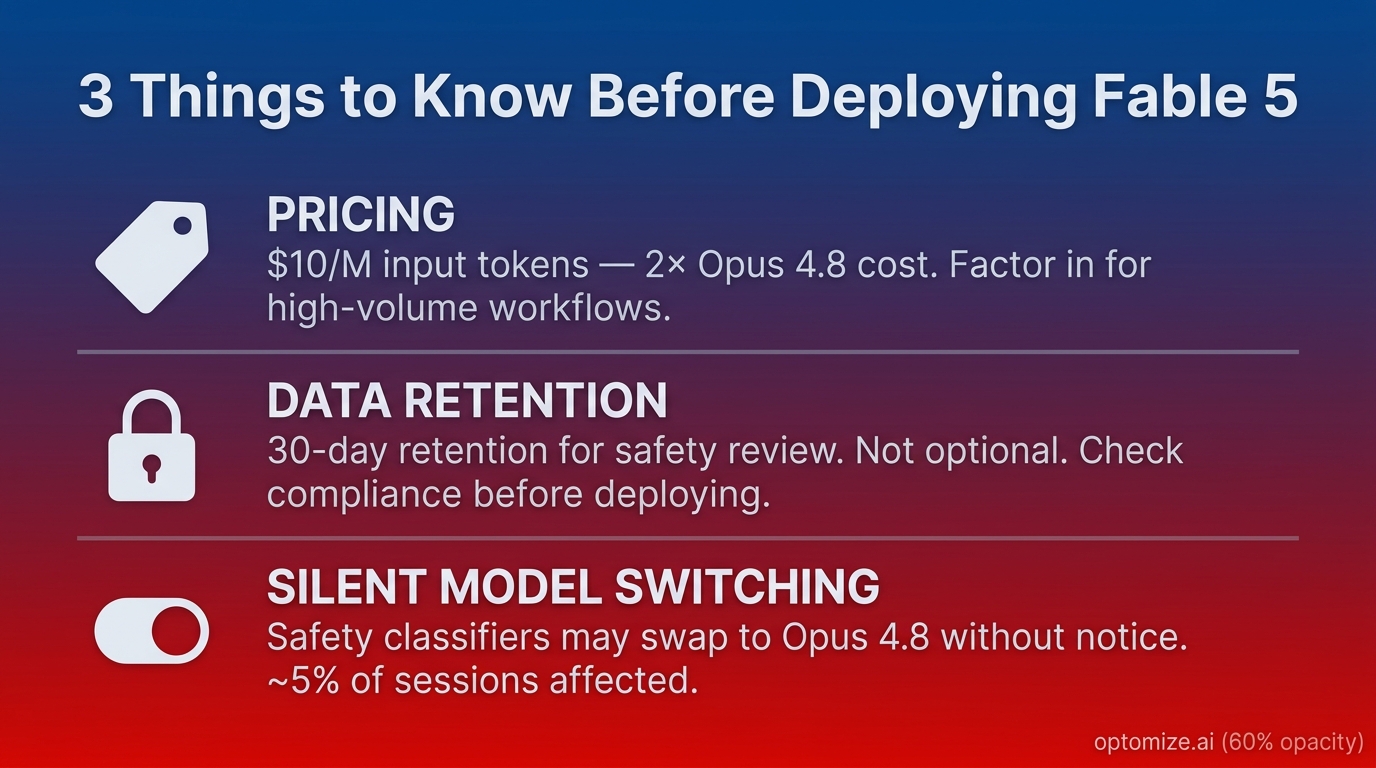
3 Catches Before Deploying
The capabilities above aren't interesting in isolation. They're interesting because of what they unlock in practice.
Autonomous agents become viable. The biggest bottleneck in most AI automation projects isn't the technology — it's the need for human checkpoints. Every time an AI gets stuck or needs clarification, a person has to step in. Fable 5's ability to maintain context across millions of tokens and work for longer without intervention removes a lot of those bottlenecks. Workflows that previously required a human review every hour can now run for a full session.
Vision-based automation opens up. If your business relies on PDFs, dashboards, reports, or web-based tools, Fable 5 can now interact with them visually. This means you can automate processes that were previously too dependent on unpredictable layouts or visual elements to script reliably.
Complex research and analysis accelerates. Tasks that require synthesizing information across dozens of documents — contract review, competitive analysis, regulatory compliance, financial reporting — are exactly where Fable 5's document reasoning capabilities shine.
Code-heavy automation builds faster. If you're building n8n workflows, custom integrations, or internal tools, you have a coding partner that can now handle the full codebase context and multi-step execution that these projects typically require.
If your business is still using AI primarily for writing drafts and answering questions, Fable 5 is a signal to revisit that scope. The operational efficiency gains are in automation, not content generation.
Want to explore what Fable 5-powered automation could look like in your business? That's exactly what we do at Optomize.
The Catches You Need to Know
This section exists because most articles about AI capabilities skip the uncomfortable parts. We won't.
Pricing is double Opus 4.8
Fable 5 costs $10 per million input tokens and $50 per million output tokens. That's roughly double what Opus 4.8 costs.
For low-volume business use, this won't register. For high-volume automation — thousands of daily requests, large document processing pipelines — it's a meaningful cost consideration that should factor into your architecture decisions.
Your data doesn't stay on your server
When you use Fable 5 through any channel (API, Amazon Bedrock, Claude.ai), Anthropic requires a 30-day data retention policy for safety review purposes. In practice, this means your prompts and outputs are stored for 30 days and can be reviewed by Anthropic staff.
If you're in a regulated industry or handle sensitive client data, this isn't optional. You need to know about it before you build production workflows.
The silent model-switching controversy
This one caught developers off guard at launch. When Fable 5's safety classifiers trigger, the system silently routes your request to Opus 4.8. No refusal message. No notification. You just get a response from a less capable model without knowing it.
Anthropic has since pledged to make this visible and add refusal reasons — but as of now, it's worth knowing the behavior exists. If you're getting inconsistent results on queries that touch security, biology, or chemistry topics, you may be hitting the classifier.
The Register documented cases where completely innocuous queries — editing a cybersecurity resume, mentioning "cancer" in a health context — triggered the fallback. Over-filtering affects a small percentage of users, but it's real.
Full Mythos 5 requires a separate application
If you need the unrestricted Mythos 5 capabilities — the full vulnerability-finding, zero-restriction access — that's still behind Project Glasswing. Fable 5 is Mythos-class, not Mythos-identical. For most businesses, Fable 5 will be more than sufficient. But it's worth knowing the distinction exists.
How to Get Access
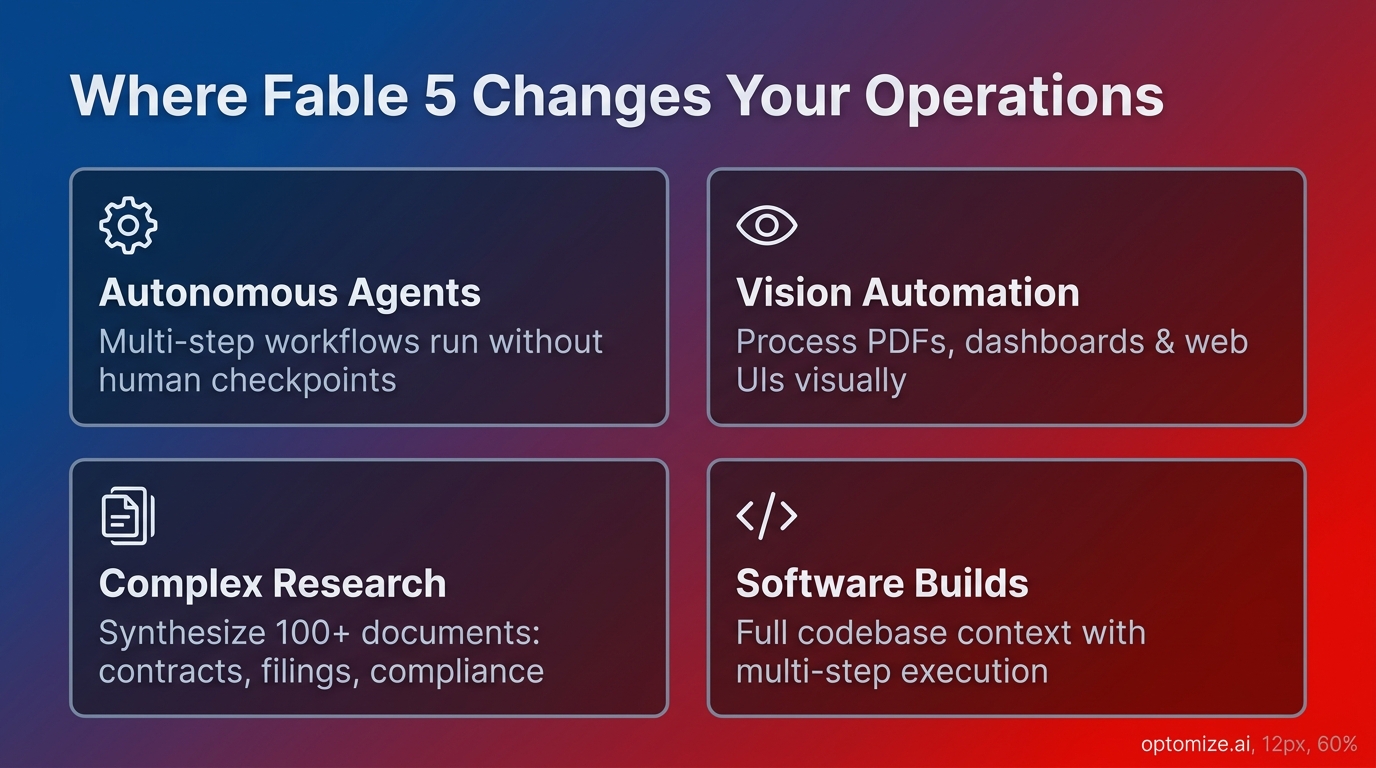
Business Use Cases
Fable 5 is available today across all major platforms:
Claude.ai (Pro, Max, Team, Enterprise) — free through June 22, then requires usage credits
Anthropic API — model ID
claude-fable-5Amazon Bedrock —
bedrock-mantleandbedrock-runtimeendpoints (US East and EU Stockholm initially)Google Vertex AI — available now
Microsoft Azure / Foundry — available now
GitHub Copilot — generally available as of June 9
If you're building on Bedrock, note that gradual rollout applies — access expands based on existing Bedrock usage. Priority access is available through AWS Support.
FAQ
How is Fable 5 different from Claude Opus 4.8?
Fable 5 is built on Mythos-class architecture — significantly more capable on long-horizon tasks, vision, and autonomous execution. Opus 4.8 is still used as a fallback for restricted queries. For most business use cases, Fable 5 is a material upgrade, not an incremental one.
Is my data safe with Fable 5?
Anthropic requires a 30-day data retention window for safety review purposes. Data is automatically deleted after 30 days in most cases and is not used for model training. However, it does leave AWS's data boundary if you're using Bedrock. For sensitive or regulated data, review Anthropic's data handling policies before deploying in production.
Why does Fable 5 sometimes refuse or give weaker responses?
Fable 5 includes safety classifiers that silently route requests to Opus 4.8 when certain topics are detected (cybersecurity, biology, chemistry, distillation). Approximately 5% of sessions hit this. If you're seeing inconsistency on legitimate queries in these areas, the fallback may be triggering. Anthropic has committed to making this behavior visible.
Do I need Mythos 5 or is Fable 5 enough for my business?
For the vast majority of business use cases — automation, knowledge work, software development, analysis — Fable 5 is more than sufficient. Mythos 5 (still restricted) is primarily designed for organizations working on national security, offensive cybersecurity, and advanced biological research. If you're not sure, you almost certainly don't need Mythos 5.
The Shift Is Happening Now
The conversation about AI in business has been stuck in a pattern: impressive demos, marginal adoption, incremental gains. Claude Fable 5 is a legitimate break from that pattern.
Not because Anthropic released a press release with impressive benchmark numbers. Because Stripe migrated 50 million lines of code in a single day. Because the CEO of a major coding tool says it's opened up problems that were previously out of reach. Because the gap between what AI can do in a lab setting and what it can do in your business just got significantly smaller.
The businesses that move fastest on this — identifying which workflows benefit most from Fable 5's autonomous capabilities, building the infrastructure to support them, and managing the cost and data considerations intelligently — will have a material advantage in the next 12 months.
The ones that wait for "the right time" will find the right time already passed.
Ready to find out where Fable 5 fits in your operations? Talk to Optomize — we help businesses in the UAE and beyond turn AI capabilities into automation that actually ships.