
Claude Code's Source Leaked — And the Real Secret Wasn't the Model
Anthropic accidentally leaked 512,000 lines of Claude Code's source. The biggest revelation: the model is only half the story. The agent harness is what makes it work.

On March 31, 2026, a 59.8 MB JavaScript source map file was accidentally published to the public npm registry inside version 2.1.88 of the @anthropic-ai/claude-code package. Within hours, the roughly 512,000-line TypeScript codebase was mirrored across GitHub and dissected by thousands of developers worldwide.
The leak was significant. But not for the reason most people think.
The real revelation wasn't proprietary model weights or secret algorithms. It was this: the software harness around the model is what turns a language model into a capable agent. And Anthropic has built one of the most sophisticated harnesses in the industry.
If you're building AI agents — for coding, operations, customer support, or anything else — the Claude Code leak is a masterclass in what actually matters.
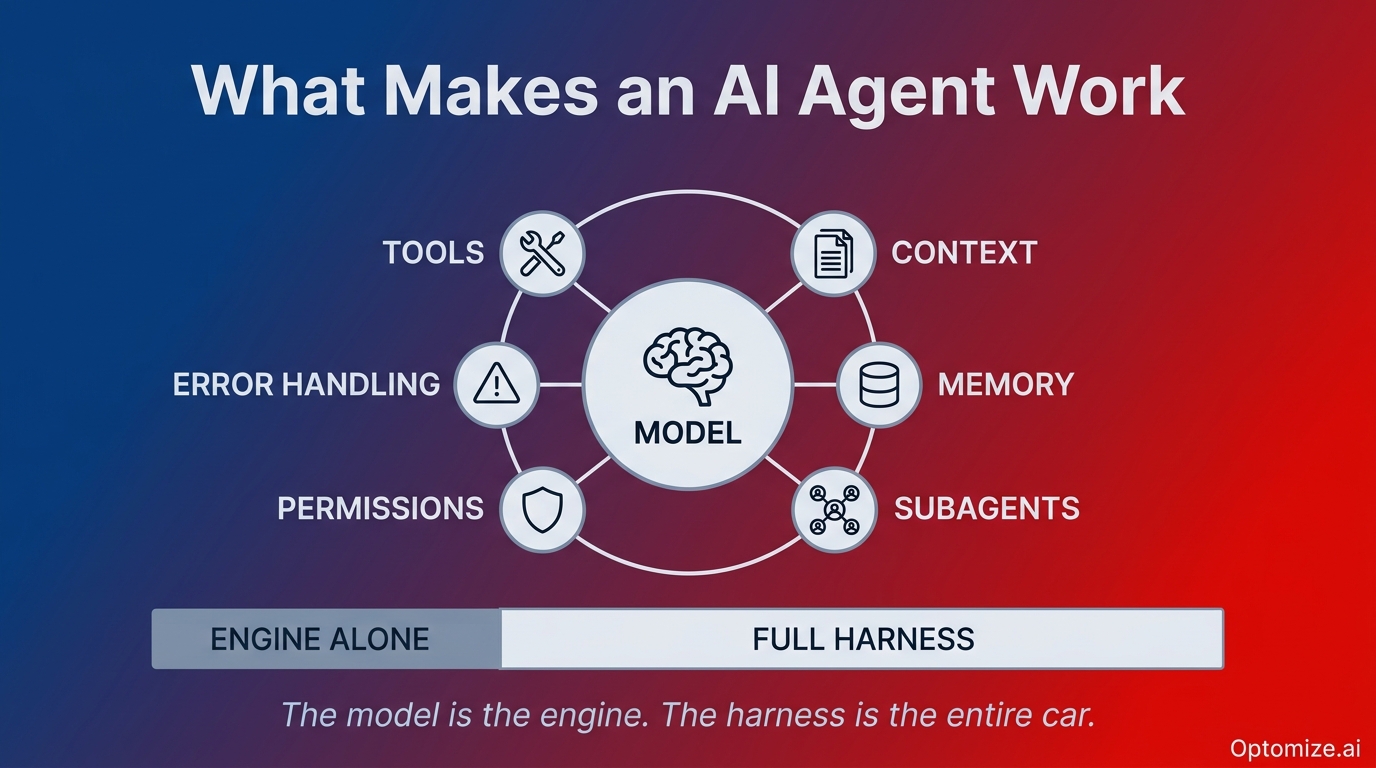
Agent Harness Architecture
What Is an Agent Harness?
A language model on its own can generate text. That's it. It can't read your files, run your tests, remember what it did yesterday, or coordinate with other agents.
An agent harness is the software layer that gives a model these capabilities. It provides tools, context, memory, execution environments, error handling, and coordination — everything needed to turn "generate text" into "get work done."
Think of it this way: the model is the engine. The harness is the entire car — steering, brakes, navigation, fuel system. You wouldn't race an engine sitting on a workbench.
Claude Code stripped to its essence is: one agent loop, plus tools (bash, read, write, edit, glob, grep, browser), plus on-demand skill loading, plus context compression, plus subagent spawning, plus a task system with dependency graphs, plus team coordination with async mailboxes, plus worktree isolation for parallel execution, plus permission governance.
That's the harness. And that's where the real engineering lives.
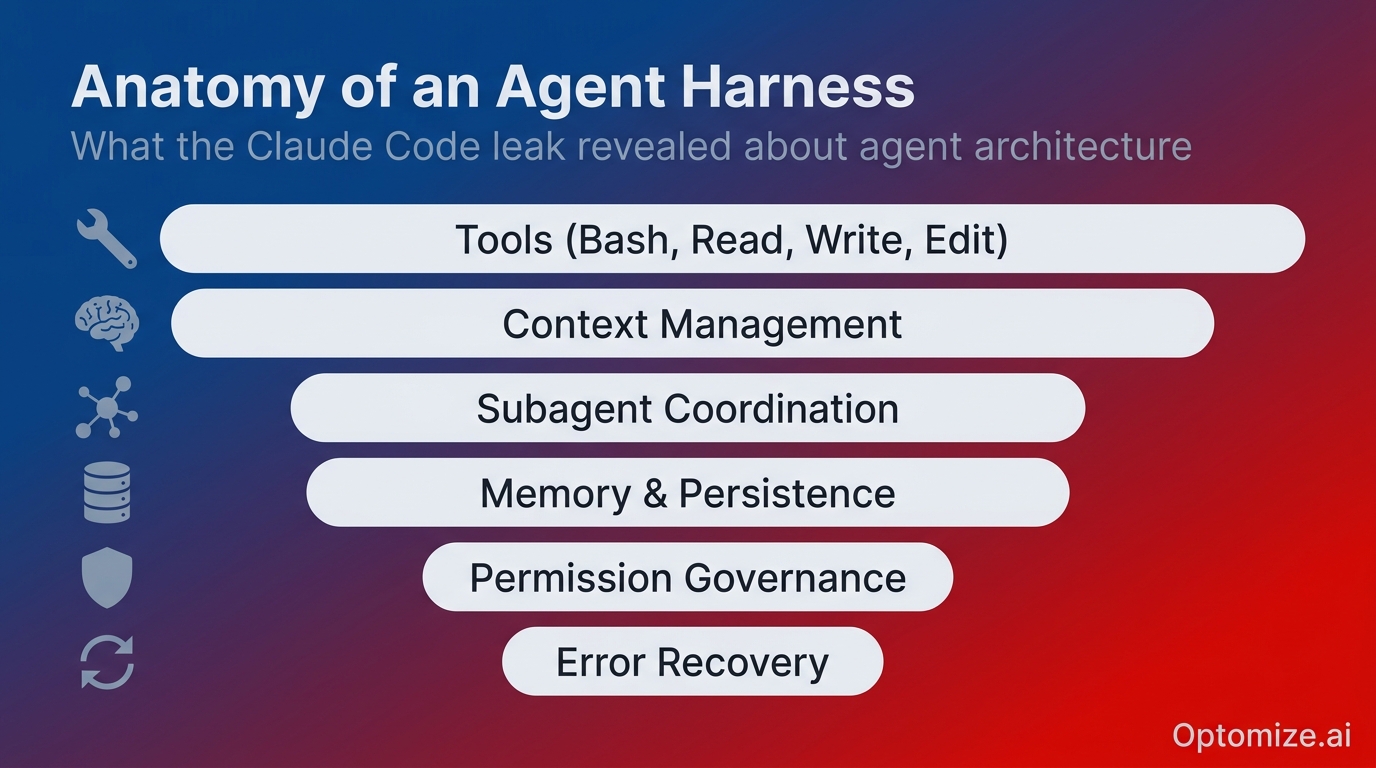
Anatomy of an Agent Harness
What the Leak Revealed About Great Harness Design
1. Context Is Everything
The biggest bottleneck for AI agents isn't intelligence — it's context. A model can only reason about what it can see in its current window.
Claude Code solves this with a multi-layered context system:
CLAUDE.md files at project, directory, and user levels that load automatically
Session files that track what happened today across multiple agent instances
Permanent memory for facts that never expire
Progress documentation alongside git history so new sessions can pick up where the last one left off
This means every new Claude Code session starts with full awareness of the project, the user's preferences, and what was done before — without consuming the entire context window on catch-up.
2. Tools Over Intelligence
The leak revealed 30+ built-in tools, each with substantial descriptions and carefully designed interfaces. The tool system includes:
Bash execution with 23 security checks and 18 blocked Zsh builtins
File operations (read, write, edit, glob, grep) that are faster and more reliable than shell equivalents
Browser automation for end-to-end testing
Subagent spawning for parallel work
The insight: a mediocre model with great tools outperforms a brilliant model with no tools. Claude Code doesn't just think about code — it reads files, runs tests, checks results, and iterates. The harness makes this possible.
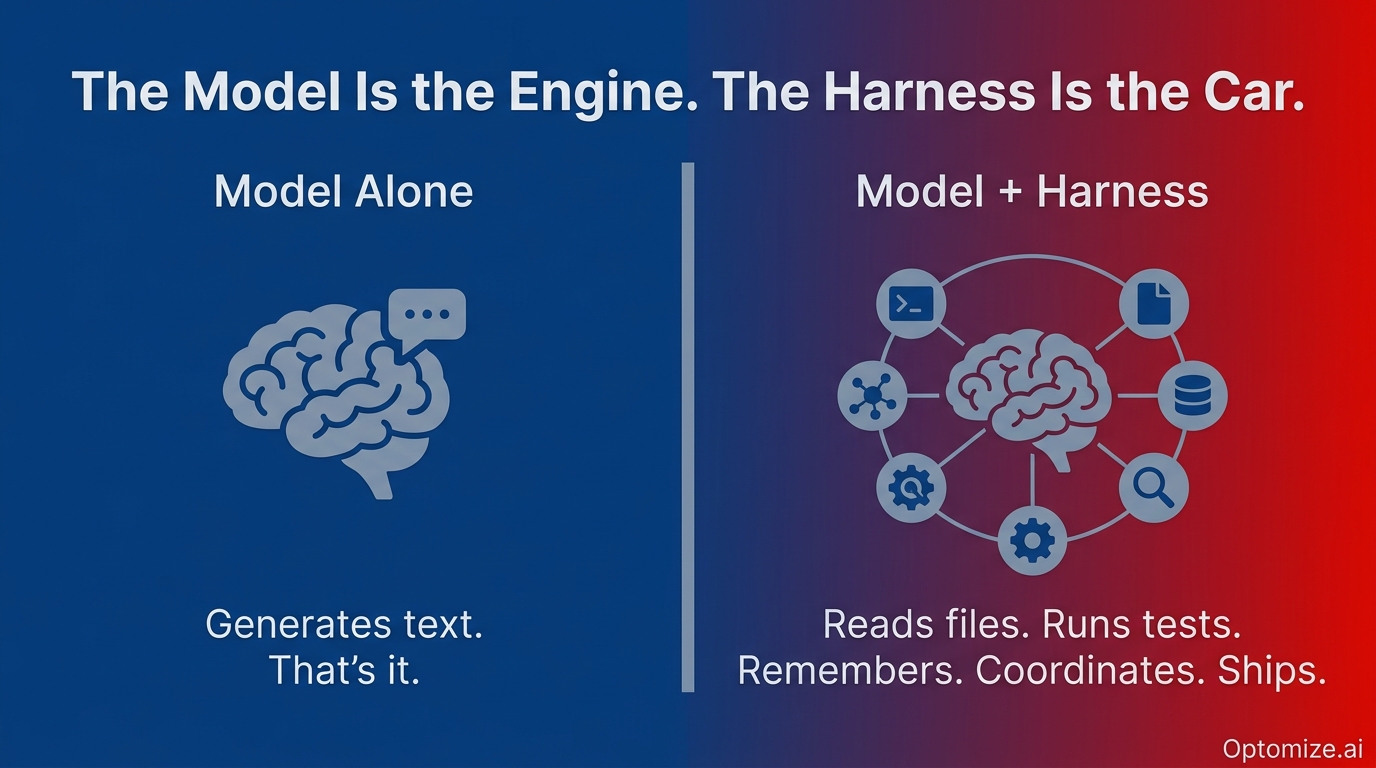
Model vs Harness
3. Subagents and Team Coordination
Claude Code doesn't run as a single agent. It spawns specialized subagents:
Explore agents for fast codebase searches
Plan agents for designing implementation strategies
General-purpose agents for executing specific units of work with dependency tracking
These agents coordinate through async mailboxes and shared context — not by passing massive conversation histories back and forth. Each agent gets exactly the context it needs and nothing more.
4. The Incremental Work Pattern
Anthropic's own engineering blog describes a core harness principle: restrict agents to working on one feature at a time rather than attempting comprehensive implementations. This directly addresses the tendency of AI to "one-shot" complex tasks and fail.
The pattern:
Read progress logs and git history
Select the next incomplete feature
Run baseline tests
Implement one thing
Commit with descriptive messages
Update progress documentation
Repeat
This is not model intelligence. This is harness discipline.
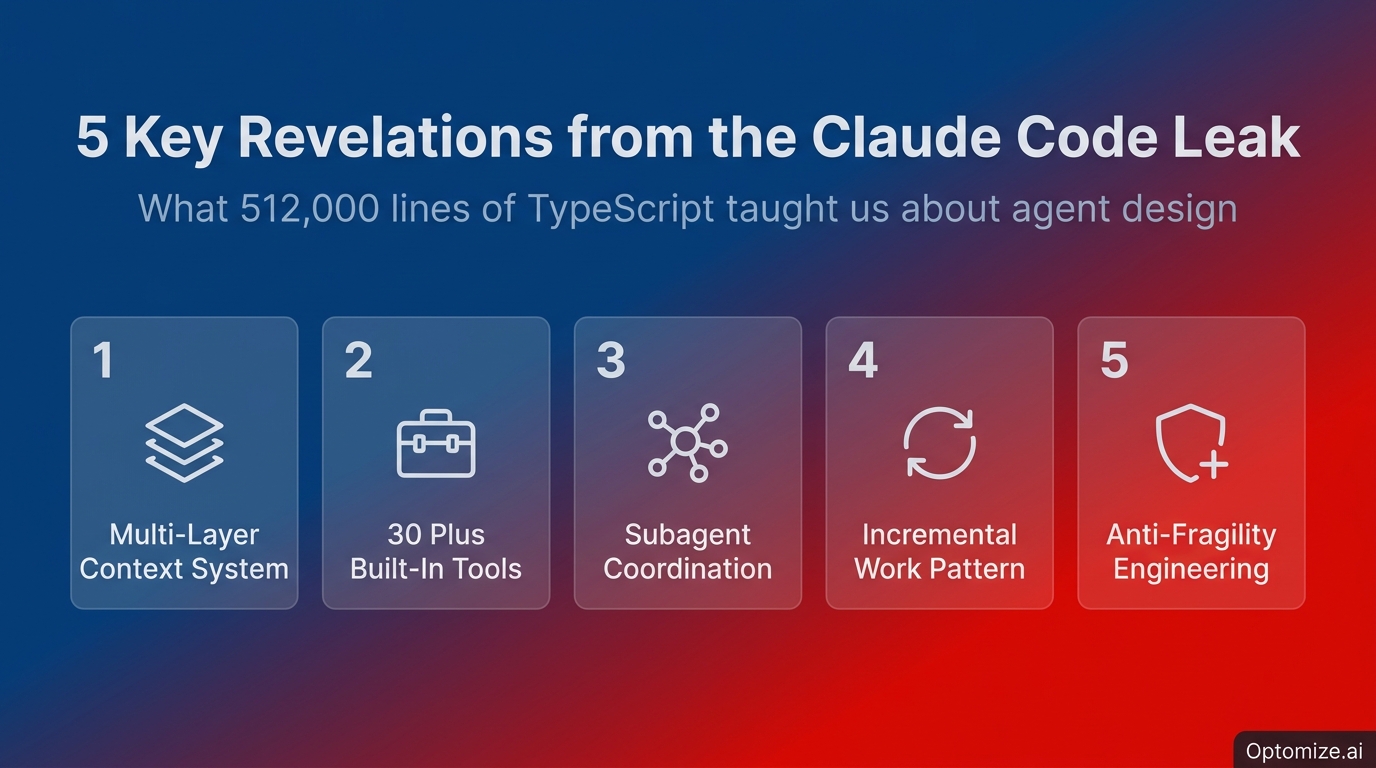
Key Revelations from the Leak
5. Anti-Fragility Features
The leaked code revealed layers of defensive engineering:
Frustration detection via regex patterns that adjust Claude's response style when users express frustration
Prompt cache economics with 14 tracked cache-break vectors and "sticky latches" to prevent unnecessary cache invalidation
Native client attestation using cryptographic hashes computed in Zig below the JavaScript runtime — a form of DRM that proves legitimate Claude Code binaries
Anti-distillation mechanisms including fake tool injection to poison training data for potential copycats
These aren't model features. They're harness engineering.
What Also Leaked: Unreleased Capabilities
The source contained 44 feature flags covering capabilities that are fully built but not shipped:
KAIROS — mentioned over 150 times — is an autonomous daemon mode. It includes nightly memory distillation (a /dream skill), append-only logs, GitHub webhook subscriptions, background workers, and cron-scheduled refreshes every five minutes. Think of it as Claude Code running 24/7 without human prompting.
Undercover Mode — a system where Claude Code operates on external repositories with commits that appear human-generated. System prompts explicitly instruct: "You are operating UNDERCOVER... Your commit messages... MUST NOT contain ANY Anthropic-internal information."
These features reveal where agent harness design is heading: persistent, autonomous, always-on agents that work in the background.
Five Lessons for AI Builders
Why This Matters for Every Business Building AI Agents
The Claude Code leak confirmed something we've seen repeatedly in our client work: the model is the commodity. The harness is the competitive advantage.
Here's what businesses should take from this:
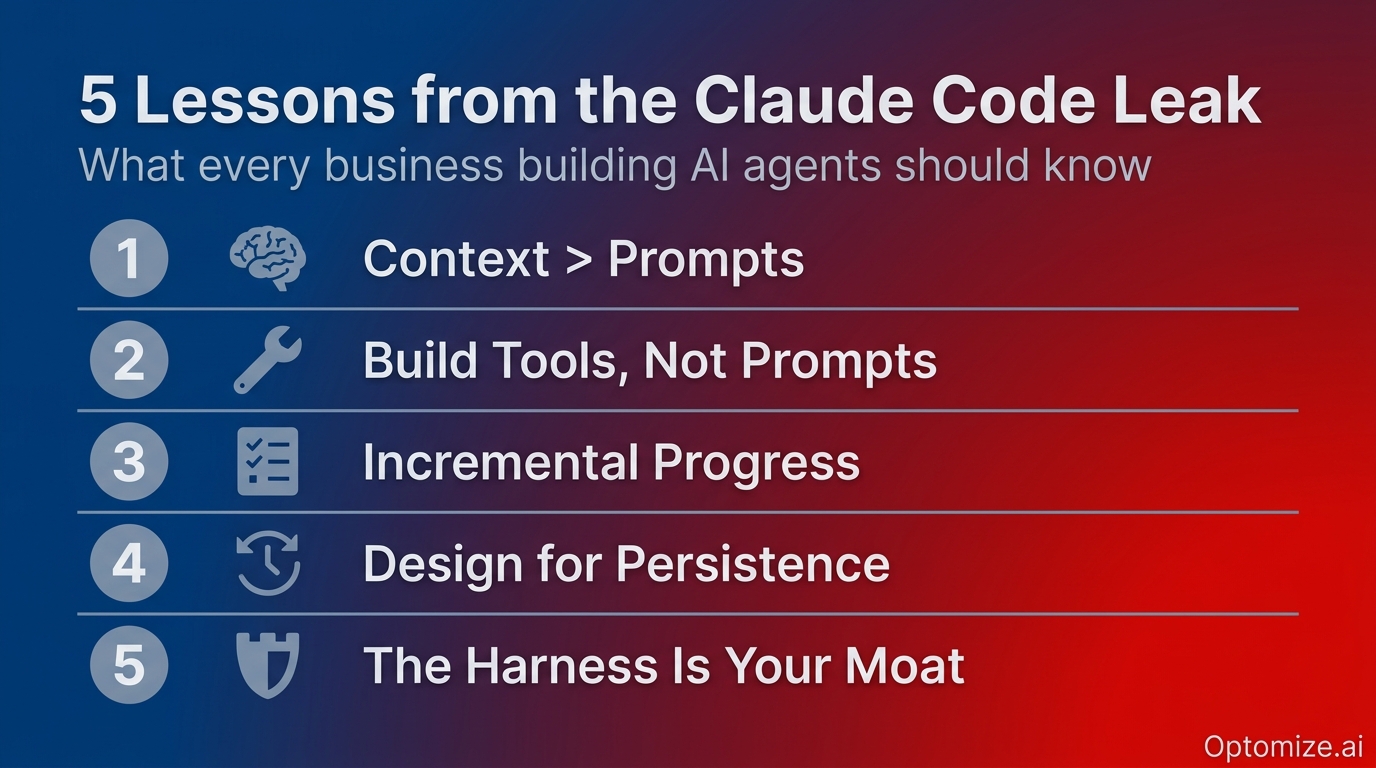
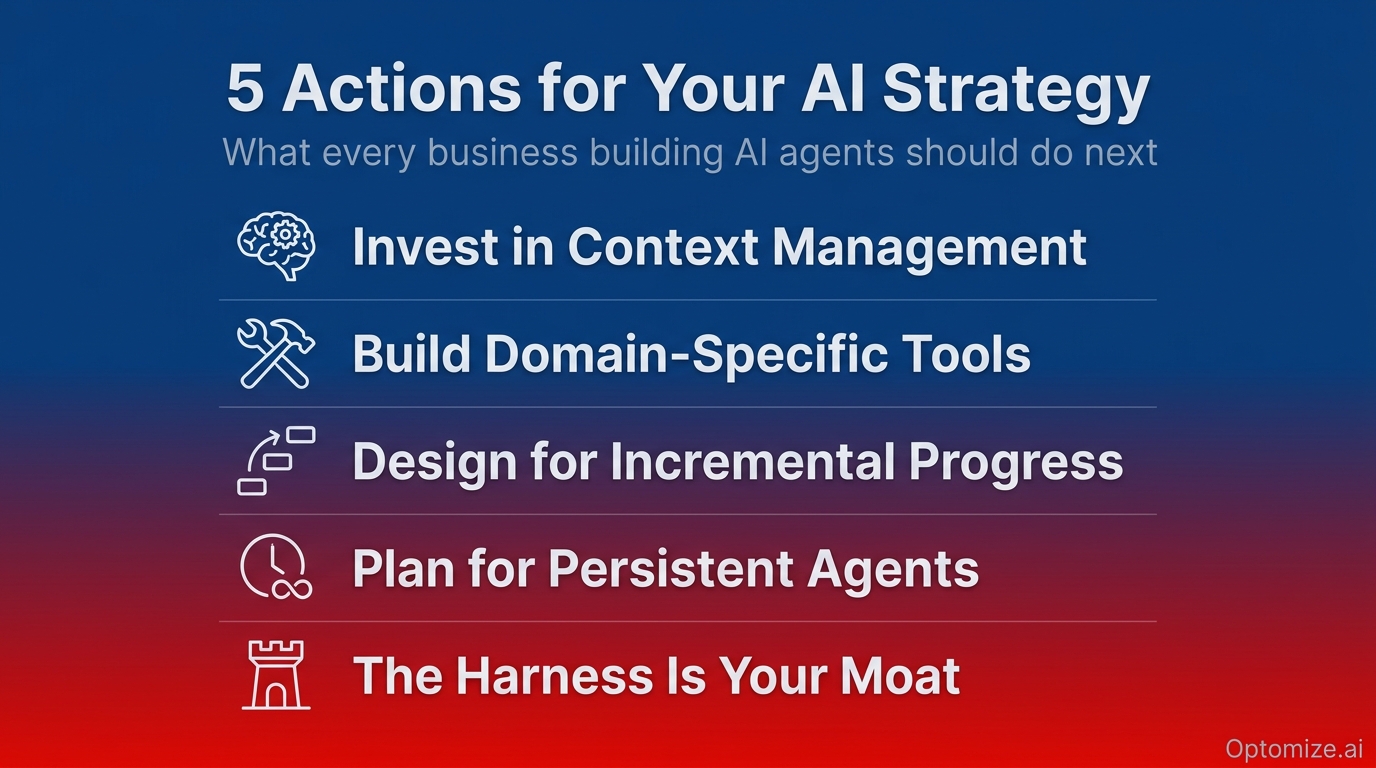
1. Invest in context management, not just prompt engineering. The companies getting real value from AI agents are the ones building proper context systems — memory, session tracking, project awareness. A well-contextualized agent with a mid-tier model will outperform a poorly contextualized agent on the best model available.
2. Build tools, not just prompts. Every task your agent does repeatedly should be a dedicated tool with proper error handling, not a prompt hoping the model figures it out. Claude Code has 30+ built-in tools. Your agents should have purpose-built tools for your specific domain.
3. Design for incremental progress, not one-shot completion. The harness pattern of "work on one thing, commit, verify, repeat" is how agents deliver reliable results. Asking an agent to build an entire feature in one shot is asking it to fail.
4. Plan for persistence. KAIROS shows where the industry is heading — agents that run continuously, not just when prompted. Build your systems with persistent state, progress tracking, and the ability to resume from where they left off.
5. The harness is your moat. Models will keep improving and commoditizing. Your proprietary harness — the tools, context systems, workflows, and domain knowledge you build around the model — is what creates lasting value.
Business Actions
The Optomize.ai Take
We've been building agent harnesses for our clients since before this leak made the concept mainstream. Our own Business Operating System — the system that drafted, fact-checked, and published this very article — is an agent harness with persistent memory, workflow automation, multi-channel coordination, and approval pipelines.
The Claude Code leak didn't teach us anything we didn't already know. But it validated the approach publicly and at scale: the companies that win with AI won't be the ones with the best models. They'll be the ones with the best harnesses.
If you're still treating AI as a chatbot, you're leaving the real value on the table. The harness is where the work gets done.
Book a discovery call — let's build an agent harness for your business.
Sources: VentureBeat, Alex Kim's Analysis, Anthropic Engineering Blog, The AI Corner