
74 Releases in 52 Days: How Anthropic Built the Flywheel That's Rewriting Software Development
Anthropic shipped 74 product releases in 52 days — because their AI writes its own code. Here's what this means for every business building software.

Most engineering teams celebrate shipping once a month. Anthropic shipped 74 times in 52 days.
Between February 3 and March 24, 2026, the Claude team pushed out a new release roughly every 17 hours. Not patches. Not hotfixes. Full product releases — new models, new features, new capabilities — at a pace that makes traditional sprint planning look like a relic.
And here's the part that should make every technology leader pay attention: the tool doing most of the building was the product itself.
The Numbers Behind the Streak
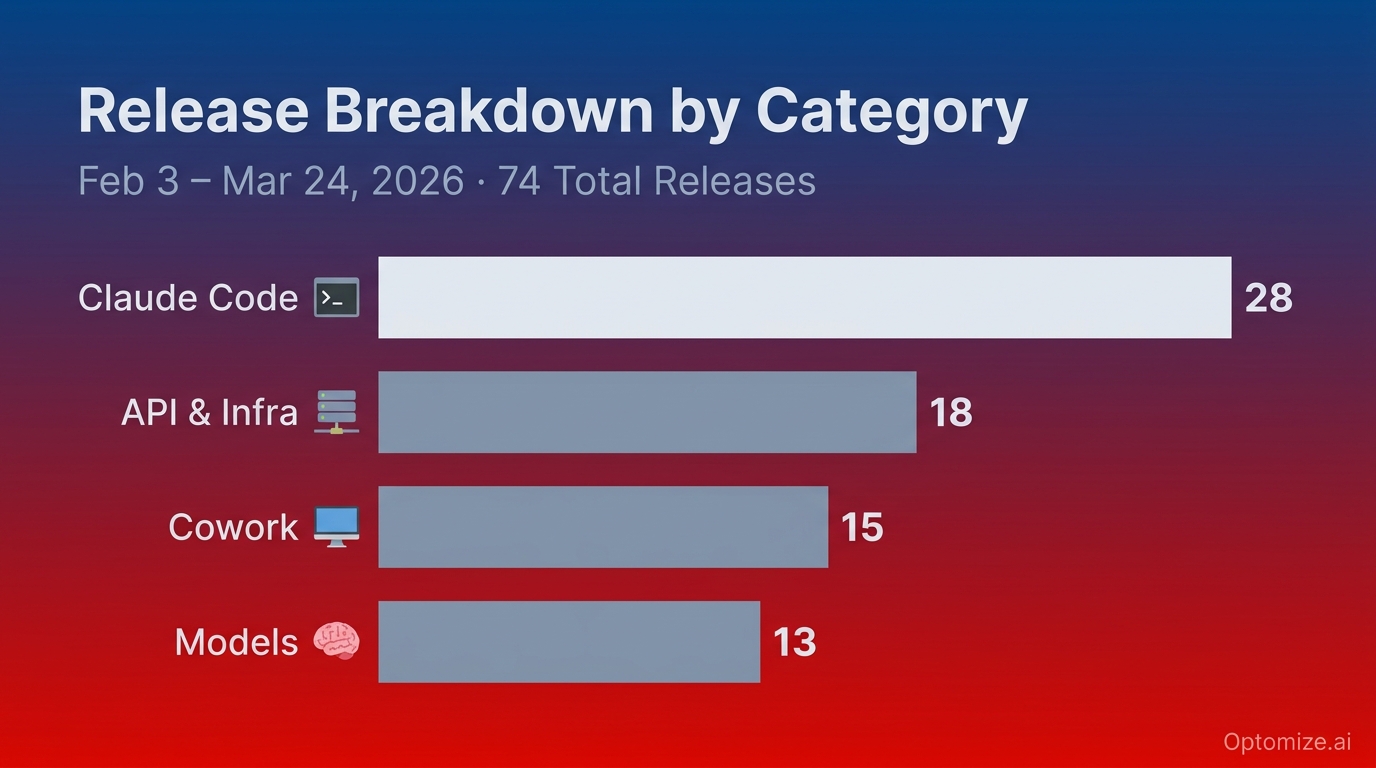
Product analyst Pawel Huryn mapped every release to a calendar. The breakdown:
Release Breakdown
Claude Code (dev tools) — 28 releases: Agent teams, multi-repo support, SSH, worktrees, voice input
API & Infrastructure — 18 releases: 1M token context (GA), Fast Opus (2.5x speed), MCP support
Cowork (desktop automation) — 15 releases: Dispatch (always-on agent), scheduled tasks, computer use
Models & Platform — 13 releases: Opus 4.6, Sonnet 4.6, Fast Opus
No single team was blocking another. Four product lines shipped in parallel, every single week, for nearly two months straight.
The Flywheel: AI That Builds Itself
This isn't just a story about working harder. It's about a fundamentally different model of software development.
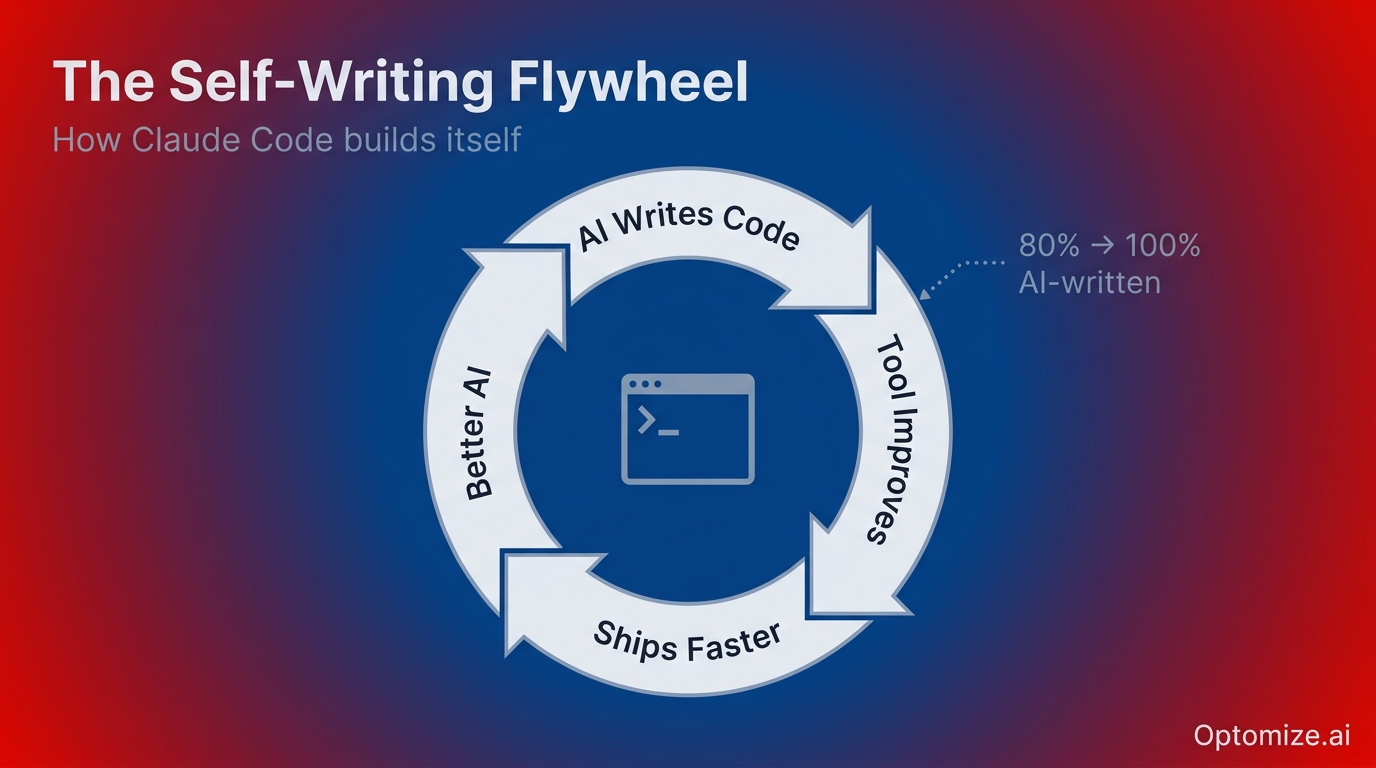
In May 2025, Boris Cherny — head of Claude Code at Anthropic — revealed that 80% of Claude Code's codebase was written by Claude Code itself. By December 2025, he said he hadn't opened an IDE for an entire month — 259 pull requests and 40,000 lines of code, all generated by AI.
By March 7, 2026, he confirmed the inevitable: "Claude Code is 100% written by Claude Code."
Flywheel Loop
Read that again. The development tool writes its own code. Every improvement to the tool makes it better at improving itself. That's not linear progress — that's a compounding loop.
And it shows in the numbers. When Anthropic doubled its engineering headcount, pull request throughput increased 67%. In any normal company, doubling the team that fast creates chaos — onboarding bottlenecks, knowledge silos, broken processes. At Anthropic, the AI handled the ramp. Over 80% of their engineers now use Claude Code daily.
Why This Matters Beyond Anthropic
You might think this is an Anthropic story. It's not. It's a preview of what software development looks like for every company within the next 18 months.
Old vs New Model
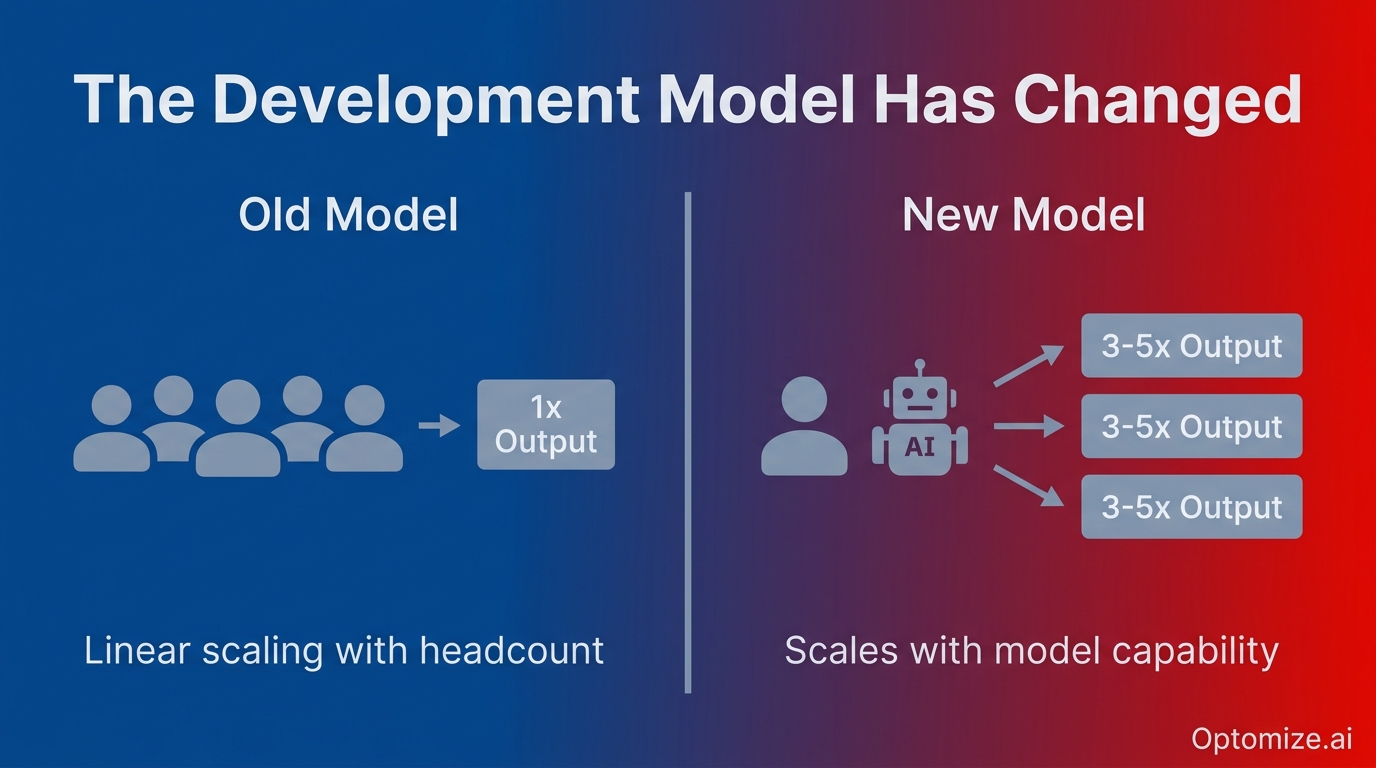
The old model: Hire developers. They write code. Ship velocity scales linearly with headcount (at best — usually worse).
The new model: Developers direct AI agents that write, test, and iterate code. Ship velocity scales with model capability, not headcount. One engineer with AI tools can produce what a team of five did before — and ship it faster.
This isn't theoretical. It's already happening at companies like:
Klarna — cut its engineering workforce by 50% while maintaining output
Replit — generates over 80% of its code through AI agents
Shopify CEO Tobi Lutke — told employees that AI usage is now a baseline expectation, and teams must prove why a task needs a human before requesting headcount
The shift isn't "AI helps developers." It's "AI is the developer, and humans are the architects."
What 74 Releases Actually Contained
This wasn't vanity shipping. The releases during this period included genuinely transformative capabilities:
Opus 4.6 and Sonnet 4.6 — New flagship models with step-function improvements in reasoning and code generation. These aren't incremental. They're the engine upgrades that make the flywheel spin faster.
1 million token context window — General availability across all tiers. You can now feed an AI an entire codebase and have it reason about the whole thing. That's not a feature. That's a paradigm shift for how software gets reviewed, refactored, and understood.
Cowork Dispatch — A persistent, always-on AI agent that runs without a local machine. Think of it as a tireless junior developer that handles background tasks while you sleep.
Computer Use — Claude can now control mouse and keyboard. This moves AI from "generates text" to "operates software." The implications for automation are enormous.
MCP Integrations — Native connections to Figma, Slack, Google Workspace, and more. The AI doesn't just write code — it plugs into your entire workflow.
The Strategic Implication for Business Leaders
If you're running a technology company — or any company that depends on software — here's what this means:
Your competitors' shipping speed is about to change. Not incrementally. Dramatically. The companies that adopt AI-native development workflows will outpace those that don't by 3-5x on feature delivery.
Headcount is no longer the primary scaling lever. The question isn't "how many developers do we need?" It's "how well do our developers use AI?" A 10-person team with AI-native workflows will outship a 50-person team still doing manual code reviews.
The buy-vs-build equation just shifted. When building custom software takes 80% less time, the calculus for building internal tools, automations, and integrations changes completely.
Speed compounds. Anthropic's 52-day sprint wasn't a one-time push. It was the natural output of a flywheel that keeps accelerating. Your competitors who start this flywheel before you will pull further ahead every month.
The Optomize.ai Take
We see this pattern every day in our client work. The gap between companies experimenting with AI and companies operating with AI is widening fast.
Most businesses are still at the "ChatGPT for emails" stage. Meanwhile, the leading edge has moved to AI agents that build, ship, and iterate software autonomously. The 74-release streak isn't impressive because of the number — it's impressive because it reveals a model of work that most companies haven't even started to adopt.
The practical question isn't whether AI development tools will transform your business. It's whether you'll be the one using them or the one competing against someone who does.
At Optomize.ai, we help companies in the UAE and across the Middle East build AI-native workflows — from automated content engines to AI agents that handle operations end-to-end. Not demos. Not proofs of concept. Systems that ship.
The companies that move now won't just be faster. They'll be playing a different game entirely.
Book a discovery call — let's map what an AI-native workflow looks like for your team.
Sources: [Product Compass](https://www.productcompass.pm/p/claude-shipping-calendar), [The Pragmatic Engineer](https://newsletter.pragmaticengineer.com/p/how-claude-code-is-built), [Kingy AI](https://kingy.ai/blog/the-mythos-flywheel-how-anthropics-secret-model-may-have-powered-its-explosive-rise/)