
Your AI Budget Is in the Wrong Department
More than half of GenAI budgets go to sales and marketing — MIT found the returns are in the back office. A four-question test for UAE businesses reallocating AI spend.

Ask a business owner in Dubai what they’ve automated with AI this year and you’ll usually get the same answer: social posts, ad copy, blog drafts, maybe a chatbot on the website.
Ask them what it saved and the room goes quiet.
That isn’t a failure of nerve or of technology. It’s a budgeting problem. Content generation is the easiest thing in AI to buy — it needs no integration, no data access, no process change, and it demos beautifully in a ten-minute meeting. So that’s where the money goes. The trouble is that’s not where the money comes back.
Almost everyone has bought AI. Almost nobody has moved the P&L.
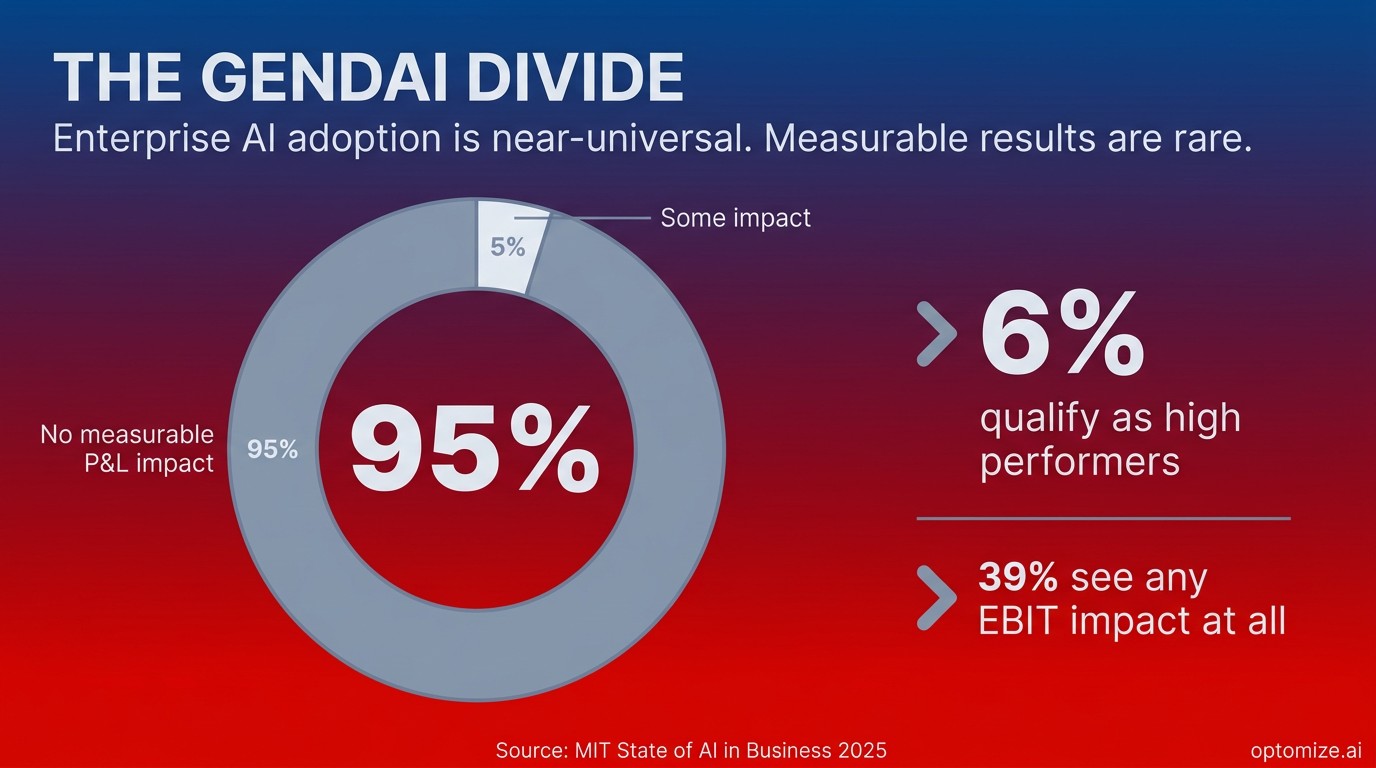
The adoption numbers are no longer the interesting part. Globally, 88% of SMEs report using AI and 72% use generative AI — but only 39% see any EBIT impact, and roughly 6% qualify as high performers. The UAE sits near the top of the adoption table: Microsoft’s January 2026 AI Diffusion Report put population-level AI usage in the UAE at 64%, ranking it #1 globally.
So the gap isn’t awareness. Nearly everyone has started. The gap is between usage and anything you can point at in the accounts.
MIT’s State of AI in Business study put a hard number on it: 95% of enterprise generative AI pilots delivered no measurable P&L impact. The researchers called it the “GenAI Divide” — high adoption, low transformation. Most of what’s been deployed lifts individual productivity a bit and changes the business not at all.
The question isn’t whether your team uses AI. It’s whether a single line item on your P&L has moved because of it.
Where the money is actually going
Here’s the finding from that same MIT work that should make you check your own spend: reportedly, more than half of generative AI budgets go to sales and marketing tools — and that’s where the measurable returns are worst. The biggest returns showed up somewhere far less exciting: back-office automation. Eliminating outsourced process work, cutting external agency spend, replacing bought-in capacity with internal systems.
Content generation is the front door of AI spend because it’s the front door of the business. It’s visible. Everyone has an opinion on it. It produces something you can look at the same afternoon.
Back-office work is the opposite. Nobody wants to sit in a workshop about invoice reconciliation. But that’s where the invoices are.
Why content generation is the default — and the wrong default
Three reasons it wins the budget by accident:
It has no dependencies. A copy tool needs a login. An automation that actually does work needs access to your CRM, your accounting system, your inbox, your file store — and someone to own that access.
It’s easy to demo, hard to measure. Twenty draft captions look like progress. Nobody tracks whether the twenty captions changed anything downstream.
It adds instead of removes. This is the real tell. Content generation almost always increases output. It rarely removes a cost. More drafts, more variants, more posts — and the same headcount reviewing all of them, now with more to review.
That last point is the whole argument. AI pays when it takes something off the books, not when it adds to the pile.
95% Stat Infographic
The reallocation test
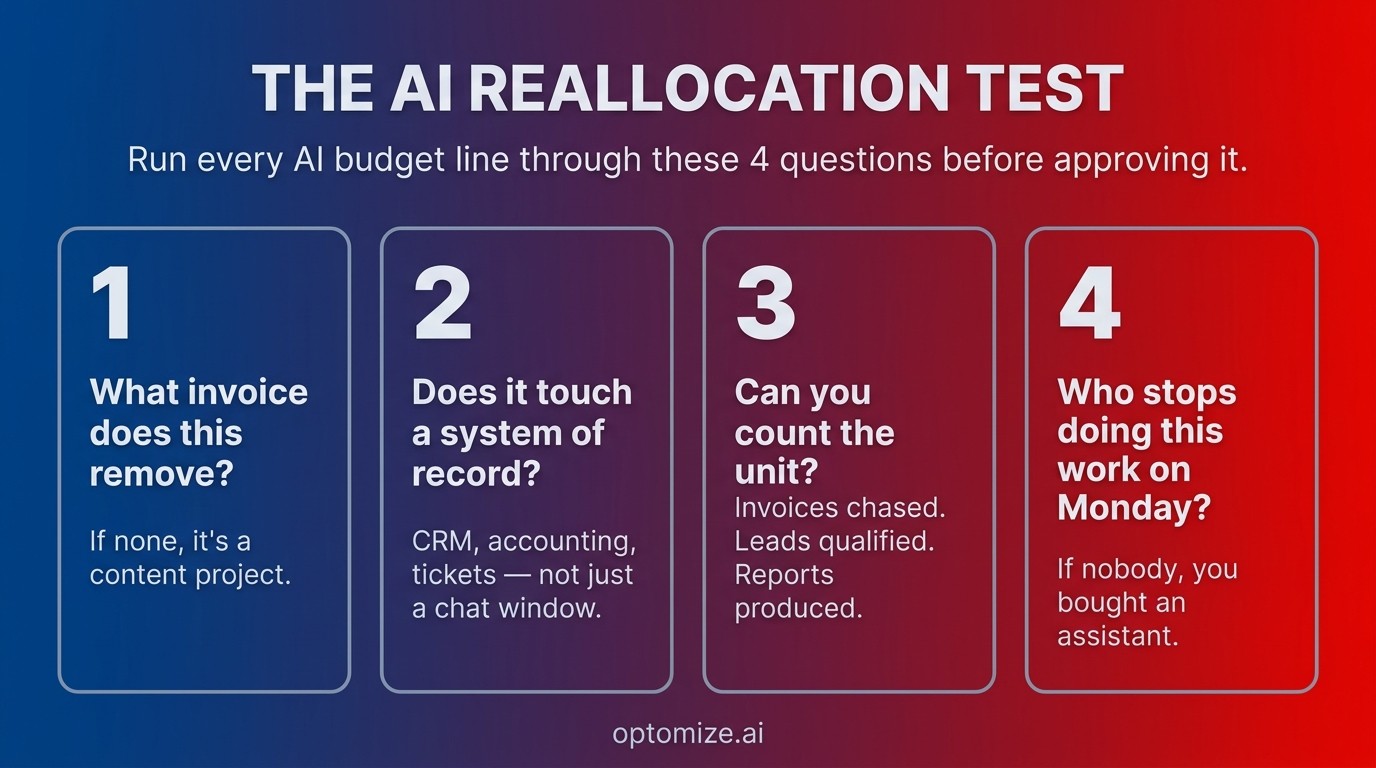
Before the next AI line item gets approved, run it through four questions. They’re deliberately blunt.
What invoice does this remove? An agency retainer, a BPO contract, a freelancer, a licence, overtime. If the honest answer is “none, but we’ll produce more,” it’s a content project — fund it as marketing, not as automation.
Does it touch a system of record? Real automation reaches into the CRM, the accounting platform, the ticketing system. If it lives entirely in a chat window, it’s a tool your team uses, not a process your business runs.
Can you count the unit? Invoices chased. Leads qualified. Tickets closed. Reports produced. If you can’t name the unit and its current cost, you can’t prove the return later — and you will be asked.
Who stops doing this work on Monday? If the answer is nobody, you haven’t automated anything. You’ve bought an assistant.
Anything that passes all four belongs in the automation budget. Anything that fails question one and question four is content — which is fine, as long as it’s honestly labelled and funded from the marketing line.
4 Questions
The exception worth understanding
None of this makes content generation worthless. It makes it conditional.
We run an AI image studio for Yellow Branding that produces campaign visuals and concept art through a multi-model routing setup. That’s content generation by any definition — and it returns, because it displaced an external spend line. Stock licensing, production time, briefing rounds with an outside supplier. It passed question one.
The same tool, sold to a business that had no external creative spend to begin with, would have produced more images and saved nothing.
That’s the distinction that matters. Content automation pays when it removes an invoice. It doesn’t pay just because it increases output. Most AI content spend in the market right now is the second kind wearing the language of the first.
What this looks like at UAE SME scale
You don’t need the enterprise version of this. At 10 to 50 people, the back office that’s worth automating is usually four or five things:
Invoice and receivables chasing — the follow-ups nobody enjoys and everyone delays, which is exactly why the money sits out at 90 and 120 days.
Lead qualification and CRM hygiene — deals going stale because logging and follow-up depend on someone remembering.
Expense and document processing — PDFs into the accounting system without a human retyping them.
Reporting and briefings — pulling numbers from four systems into one view someone actually reads on a Monday morning.
Inbound triage — routing what comes in, so the right thing reaches the right person the same day.
None of these will get a round of applause in a management meeting. All of them are countable, all of them touch a system of record, and all of them answer question four with a name.
We run our own business on exactly this stack — briefings, approvals, follow-up chasing and reporting all run as automations against our real systems, not as a chat assistant we consult. It’s unglamorous, and it’s the reason a one-person consultancy can hold a pipeline that would normally need an operations hire.
Our take
The market has spent two years buying the most demonstrable form of AI and the least accountable one. The correction is already visible in the data: adoption near-universal, measurable value rare, and the biggest returns sitting in the parts of the business nobody wanted to talk about.
If you’re allocating AI budget for the next quarter, the single most useful move is a reallocation, not an increase. Take the four questions above, run them across everything currently funded, and move the money to whatever answers question one with an actual number.
That’s the work we do at Optomize.ai — finding the processes in a business that have a countable cost, and automating those first. Not more output. Less overhead.
If you want a straight answer on where your own AI spend should sit, book a short call and we’ll map it against your actual cost lines.